

Who is Päivi Räsänen and Why Should Canadians Know About Her?
why do we need hate laws, continued, or why Canadians should reject the removal of religious exemption from (section 319) hate laws, and even consider striking the hate law altogether

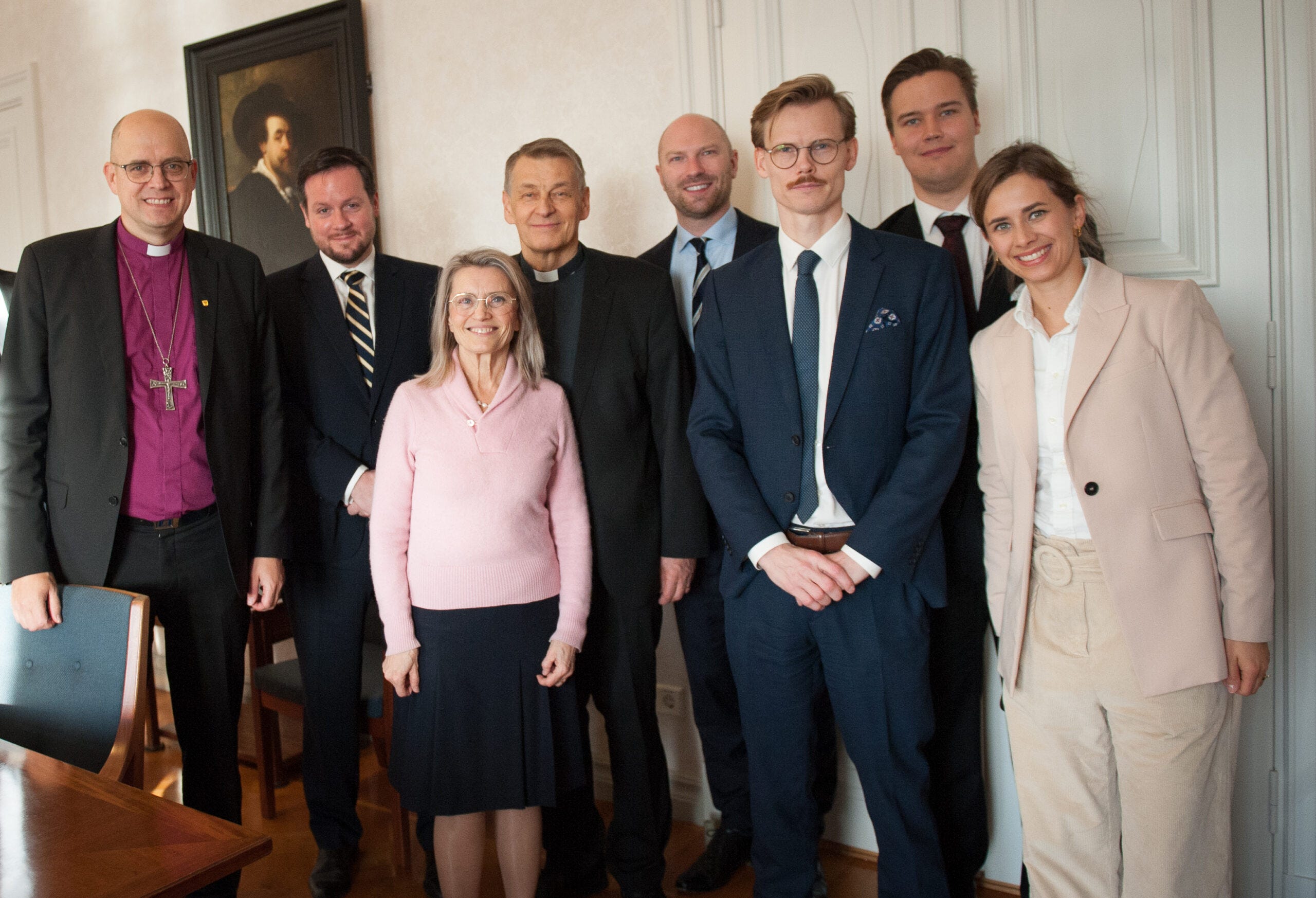
📸 :: photo courtesy of ADF International, October 30, 2025
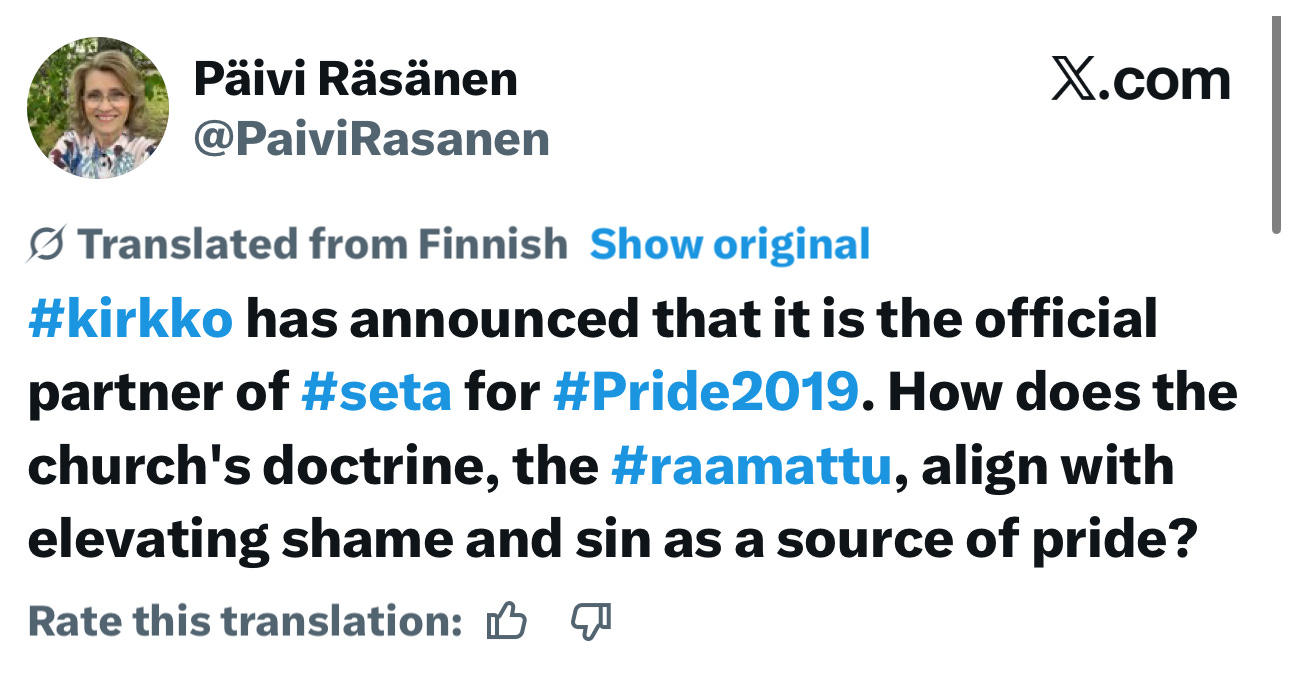
On June 17, 2019 Räsänen—a medical doctor, pastor’s wife, member of parliament under the Christian Democrats Party (which she led for 11 years ending 2015), and former Minister for the Interior—tweeted her reaction to news that her church had endorsed the Helsinki Pride event. Räsänen attached a screenshot of Romans 1:24-27 to her tweet which read “[the] Evangelical Lutheran Church has announced that it is the official partner of Seta for Pride2019. How does the church’s doctrine, the Bible, align with elevating shame and sin as a source of pride?”1
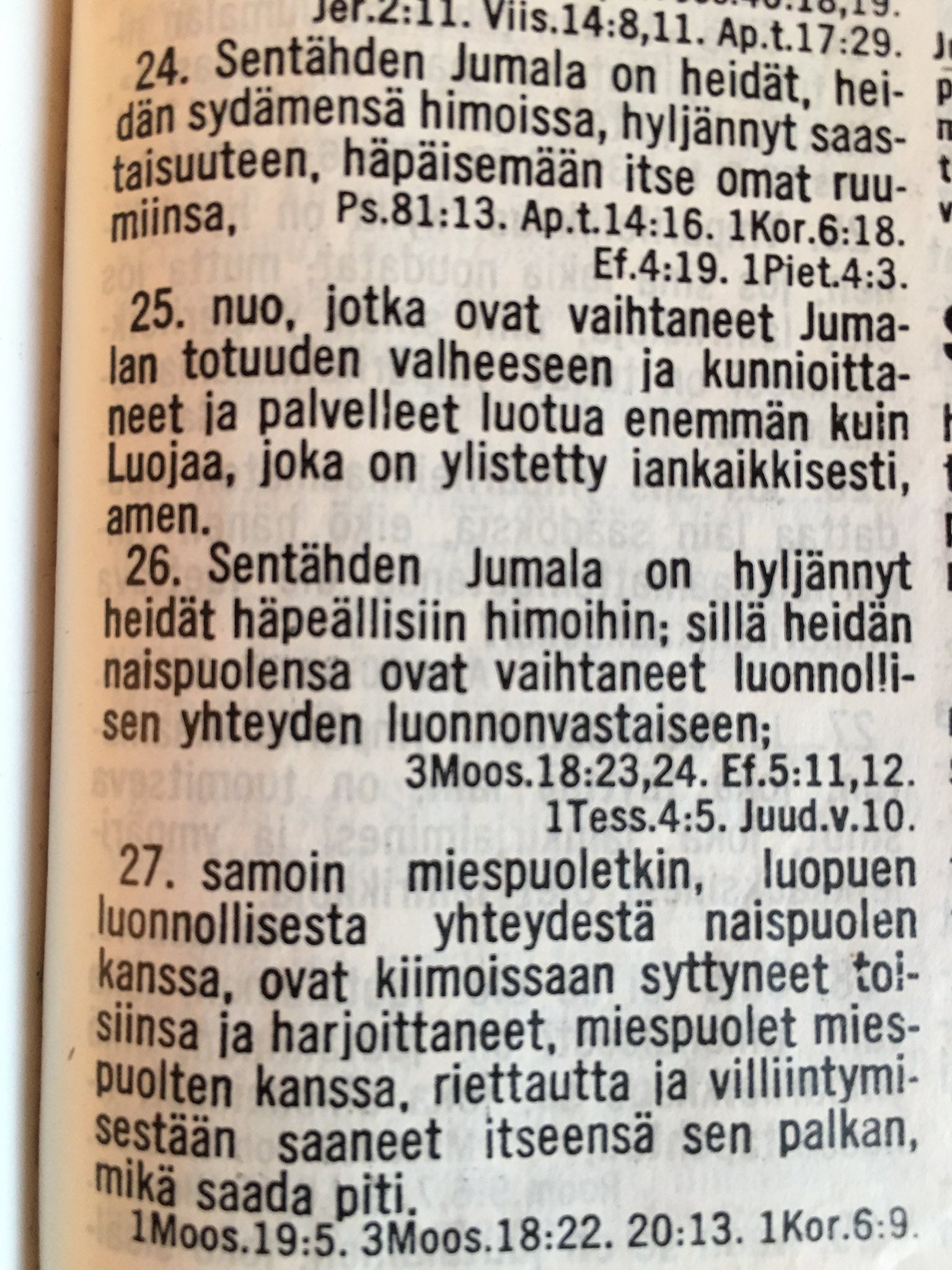
📸 :: this is a screenshot of Romans 1:24-27 from a Finnish translation of the Bible2
the police officer asked Räsänen to explain the word ‘sin’
Räsänen expressed a concern shared by many Christians in the Evangelical Lutheran Church, in which her husband works as a pastor. Räsänen heard from many Christians who told her they planned to leave the church over its decision to capitulate to its progressive wing and support the LBGT community and endorse and possibly sponsor the Pride event. A few weeks later she read in the local newspaper about a police investigation relating to her tweet.
The policeman asking questions kept an open Bible on the table between them. He pointed at it as he probed her theology: “What is Romans about?” “Tell me about the first chapter.” “Walk me through Genesis.” “Explain this word, ‘sin.’” — ADF International, March 3, 2025
Over a period of several months Räsänen spent a total of 13 hours at her local police station, in interrogations regarding her public statement regarding the Evangelical Lutheran Church supporting the Pride movement. After a year, Räsänen learned that the Finnish Prosecutor General planned to charge her “… with three counts of “agitation against a minority group” — one, for publicly voicing her opinion on marriage and human sexuality in a 2004 pamphlet distributed at her church; two, for comments she made on the same topics on a 2019 radio show; and three, for the tweet directed at the leadership of her church” (ADF International, March 3, 2025). In Finnish law agitation of a minority group falls under war crimes and crimes against humanity, and offences carry a penalty ranging from thousands of dollars in fines to a two year prison term. Räsänen would face charges with Bishop Juhana Pohjola, co-author of the 2004 pamphlet in question.
[States pass hate speech laws] as a way “to reduce social tensions, to curb hostility, to foster conditions of peace. It’s a very reductive way of looking at societal problems … the idea that if you have less ‘hate speech,’ you’ll have less hate … [Unfortunately, the laws are also] vaguely worded, overly broad, and don’t define ‘hate,’ [which] …really, is just in the eye of the beholder. And what happens is what we’ve seen with this case: people are prosecuted for perfectly peaceful expression in the name of preventing ‘hate.’” — Elyssa Koren, legal communications director for ADF International via ADF International, March 2025
Last week, in Why Do We Need Hate Laws, I wrote about hate legislation and grappled with defining and describing hate. I argued for (criminal) hate as a rarity in Canada, based on case law history related to Criminal Code Section 319. I proposed that, what progressives describe as hate, actually we could better describe as a mimetic phenomenon. A thoughtful reader left a comment regarding a semiotic analysis of hate, to compare and contrast with my mimetic analysis of hate, “… there is no genuine hate existing there - as you’ve plausibly asserted in your post - but rather it’s something like an ersatz hate almost. And where, say, a target of opportunity just happens to be the convenient and timely victim of someone exercising their regrettable manifestation of stereotyping and caricature of an Out Group member.”
Reader, can we at least consider that progressives want hate speech laws to serve as pillars for the platform of their culture of identity politics? The laws we have work when enforced, as we’ve seen from the case of Pastor Derek Reimer. We didn’t even need hate laws to convict Reimer of criminal harassment. We don’t need hate laws to prosecute him for disturbance and mischief. No hate law needed, either, to ban him from going within 200 metres of LGBTQ2S+ events. Because the laws we have in Canada works when law enforcement enforces it! They’re not gonna work when we choose not to enforce them, as with Adil Charkaoui, whom the PQ Crown prosecutor chose not to charge with hate. Reader, will the Bloc-amended Bill C-9 fix that? If you think so, then I have a fridge to sell you, LOL.

📸 :: The “… common longing for and against certain models, raises a fundamental question: Do we, in fact, have any autonomy?” —via Sprout
So, returning to the story of Räsänen. In March 2022, the Helsinki District Court acquitted Räsänen and Pohjoja on all counts, stating that interpretation of Biblical texts lay beyond the purview of the court. The state prosecutor appealed the decision. In November 2023 the Court of Appeals held up the acquittal. Undeterred in his mission, again, the state prosecutor appealed the decision. The Supreme Court, recently heard oral arguments on the case. In the oral arguments presented to the Supreme Court on October 30th, 2025, the prosecution argued for the Bible verse in question as hate speech, claiming intent irrelevant, because only the readers’ interpretation matters in the determination of hate speech.
“In the hearing, prosecutors reiterated their claim that Räsänen’s words were “insulting” and that “intent is irrelevant” — and that what matters is how readers interpret the text.” — ADF International, October 30, 2025
The prosecution requests that Räsänen and Pohjola receive a conviction of the hate crimes agitation of a minority, together with imposition of a fine, and internet censorship of the 2004 church pamphlet on marriage and sexuality, called Male and Female He Created Them: Homosexual relationships challenge the Christian concept of humanity.3

“Our fundamental rights quite correctly prohibit discrimination against people based, inter alia, on sexual inclination … Our Constitution also prohibits discrimination on the basis of religious convictions, but it does not require the marriage law to be changed to allow for polygamy, even if, for example, the Islamic minority insists on it, appealing to their human rights or their private standards of sexual ethics.” — Räsänen and Pohjola, Male and Female He Created Them: Homosexual relationships challenge the Christian concept of humanity, 2004.
Much as I disagree with the exegesis of the Pauline Biblical text Räsänen and Pohjola cited to support their position, as representative of the Lutheran Heritage Foundation, in describing a Christian position on same sex attraction and marriage, I think they make a valid point here, in the above excerpt. Do we feel the need to expand marriage to accommodate polygamy, even child marriage, simply because a few powerful minority groups demand it as a human right? Why? Do we really want to adopt hate speech laws to protect identities? Why? Will it become hateful to protect girls from child marriage, as it now has become to protect their sports and their right to same sex change rooms and public toilets and other accommodations, such as in school camp excursions? How far do we take this identity thing?
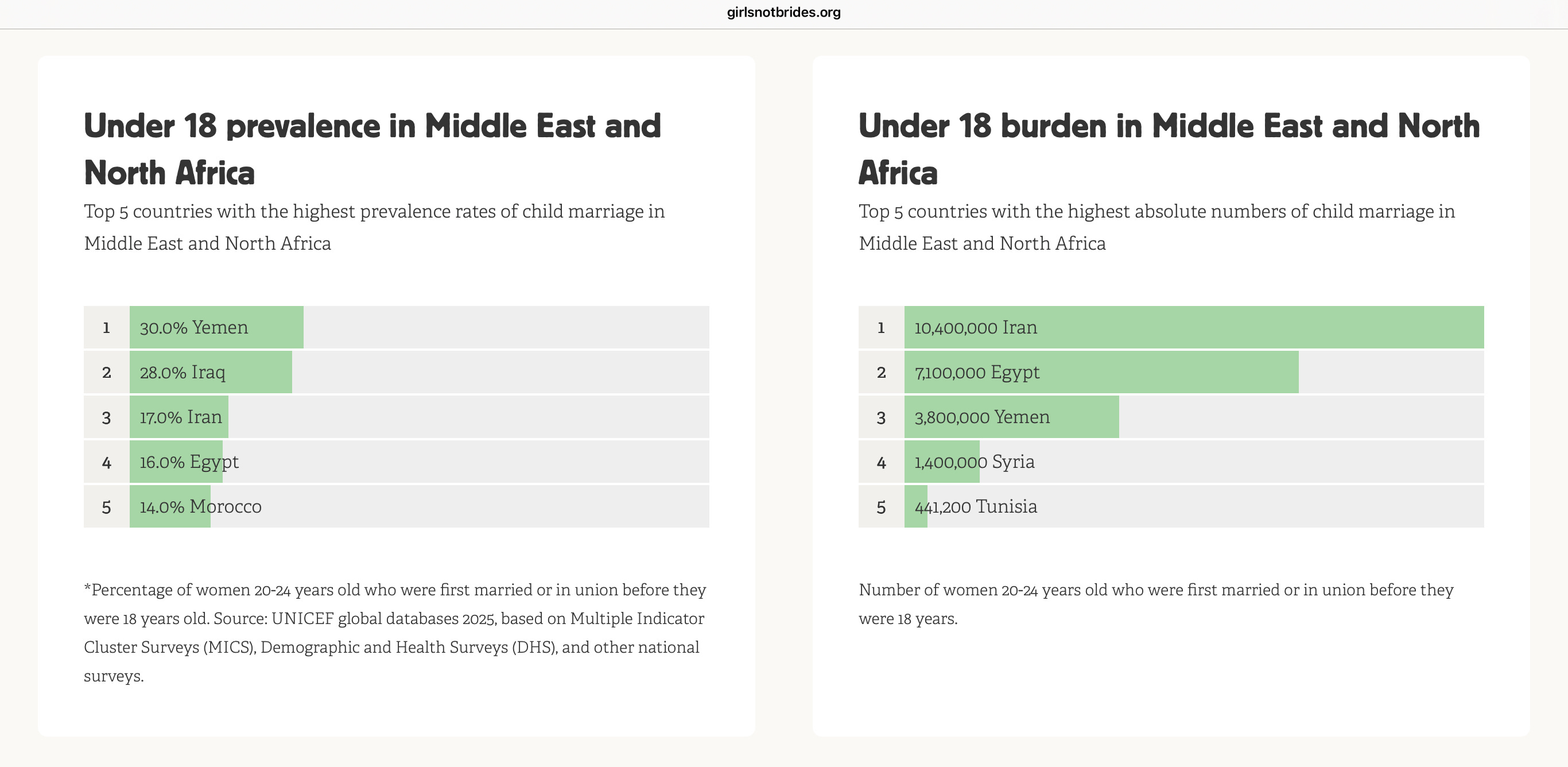
📸 :: screenshot regarding countries with legal child marriage, via Girls Not Brides.
“What the prosecutor essentially is calling for is the criminalization of the orthodox Christian position on fundamental Christian doctrine regarding marriage, sexuality, sin, and so forth. It’s shocking to see such brazen anti-Christian legal argumentation within a criminal context.” —Paul Coleman, Executive Director of ADF International
The proposed Bill C-9 defines hate as “the emotion that involves detestation or vilification and that is stronger than disdain or dislike.”
What does this definition of hate mean, practically? What is free expression? What is the right to express reasonable comment on important public issues? What is religious freedom? What limits do we place on religious freedom? What limits do we place on identity culture? When does identity become an idol? When does identity culture force us all to worship the pagan god designated by the state? What do we hope to accomplish and gain with Bill C-9? What benefit will removing the religious exemption in 319(3) bring Canadians? What purpose did the exemption serve, in the first place? Think about these questions and the direction you would like Canada to take from here, reader.
Why would anything a religious person says matter to an atheist or non believer? If you don’t believe in Christianity then what a Christian says about the sin of a lifestyle choice shouldn’t have any import, should it? It only becomes hate when they use sin to incite violence. Or to be a menace, such as in the case of Pastor Derek Reimer.
This is an excerpt of Paul’s letter to the Romans. It has a specific cultural context. It’s common practise for conservative Christians to strip away that important context from Pauline epistles and project their own modern political meaning into Paul’s writings. Paul addresses struggles facing Christian congregations— namely the orgy culture of Greek and Roman pagan cultures, the problem of unrestrained lust, selfish excess in contrast to moderation. When being true to the text in a scholarly exegetic manner, it’s doubtful we could conclude Paul had in mind modern day sexual orientation when he wrote this or any other epistle. In the New Testament, there is not the easy condemnation of modern day same-sex sexual orientations as some Christians wish there was.
I’ve read this 24 page document and I disagree with a lot of it. I disagree with the interpretation of Pauline theology as expressed in the epistles, because I reject the idea that Paul had in mind modern day sexual orientation when he planted his churches and when he wrote his letters to these congregations. It’s lazy exegetical scholarship to use Paul or and other Biblical texts to support a modern day political agenda, ideology, point-of-view. I’m not gonna spent time analysing this pamphlet in this piece, such an endeavour warrants its own essay, which I will probably write in due course.