

Why Do We Need Hate Laws?
not only do I find the religious exemption for hate expression problematic, I also find the criminal offense of hatred itself problematic

What is hate? Why does Canada criminalise it? The current version of the criminal code fails to define hate in a fashion that could render the law useful. It really leaves a great deal up to the judiciary, as far as interpretation of the hate law and its application to a situation. Do we want to give that kind of power over humans to anyone? Why do we want to give that kind of power over humans to anyone? Humans lack the trustworthiness and ethical responsibility and intellectual skill to wield such power over each other. Definitely the Canadian Crown Counsels and judiciary have demonstrated their untrustworthiness in this regard, owing to their vulnerability to ideological capture of the institutions in which they work.
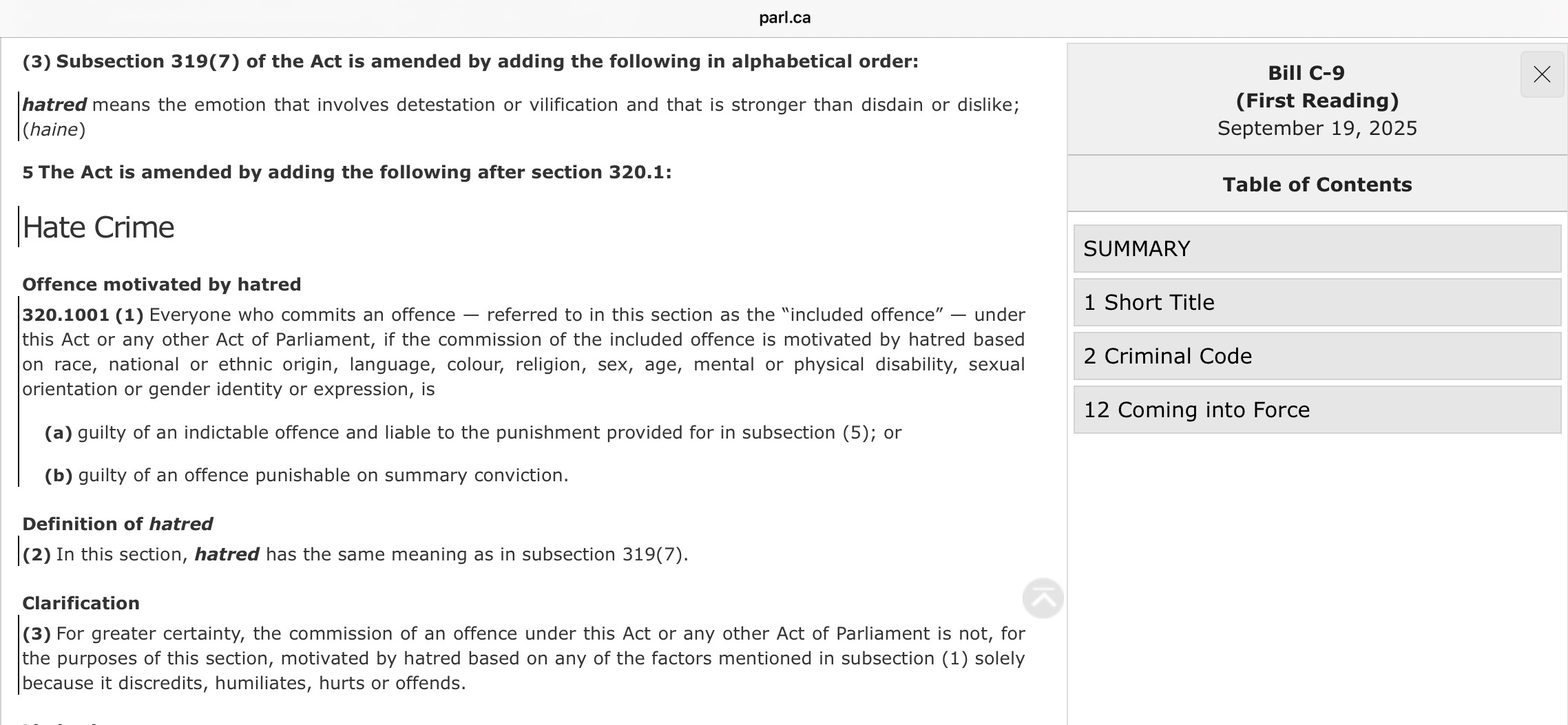
According to the BC Human Rights Commission, hate has the following description.
Hate speech comes in many forms. It can include hatred rooted in racism (including anti-Black, anti-Asian and anti-Indigenous racism), misogyny, homophobia, transphobia, antisemitism, Islamophobia and white supremacy.
Both Canada’s Criminal Code and B.C.’s Human Rights Code describe hate speech as speech that has all of these three features:
It is expressed publicly
It targets a person or group of people with a protected characteristic such as race, religion or sexual orientation
It uses extreme language to express hatred towards that person or group of people because of their protected characteristic
Hate speech uses extreme language to describe the targeted group that is likely to expose them to detestation and vilification. Here are a few examples of what hate speech typically includes:
Describing group members as animals, subhuman or genetically inferior
Suggesting group members are behind a conspiracy to gain control by plotting to destroy western civilization
Denying, minimizing or celebrating past persecution or tragedies that happened to group members
Labelling group members as child abusers, pedophiles or criminals who prey on children
Blaming group members for problems like crime and disease
Calling group members liars, cheats, criminals or any other term meant to provoke a strong reaction
Hate speech is not limited to the types of negative words in these examples. But these examples show how disgusting and extreme speech must be to be considered hate speech under the law.
B.C.’s Human Rights Commissioner recognizes that there is a lot of speech that is hurtful and offensive that is not captured under hate speech laws.
Why do we need to make up rules and laws about hate speech? How can we try to control a normal human emotion with all these definitions? And to what end do we do this? As I look at this description of hate speech from the BCHRC, I can see the futility of such an approach to addressing hatred. Can we get away from circular definitions such as “hate speech…can include hatred rooted in racism…” and if we cannot, then, we have not added to the understanding of “what is hate speech,” have we?
Why has the BCHRC not included Arab or Black or Asian or Indigenous supremacy in their “hate rooted in racism” description? Why only white supremacy? This strikes me as an ideologically skewed understanding of racism and hate. Can we treat racism and hate as synonymous, really? How do we account for the mimetic nature of racism as distinct from the emotive nature of hate? Finally, when I look at the examples of hate speech the BCHRC listed, well, these things happen routinely on our streets and on our social media platforms, and in our culture of communication—the authorities do nothing. And, really, what could the law enforcement and political leadership do (in a fruitful and constructive manner) to disrupt or discourage this behaviour?
We have decided to make hate about protecting identity instead of humans. That means we have decided to make hate laws about protecting the sanctity of ideas that people have about themselves and in which they believe, as opposed to humans themselves. We have seen many of these examples of hate speech provided by the BCHRC list used by Islamists against Jews. We have seen them used by a variety of conservative-leaning people against those who promote gender ideology. I don’t see these expressions as worthy of criminal prosecution. I don’t see the point for any human rights commission — any elite and bloated organisation comprised of politically appointed officials given the task to morally adjudicate human behaviour compromise democracy and freedom. We find ourselves subject to the whims of these radical appointees, whom we did not elect. They wield a lot of power over the lives and livelihoods of individuals. Ultimately, fighting hate and racism becomes an identity-based power grab, a means to keep thought criminals and wrong-speakers in line.
“From a pure internal logic standpoint, the Bloc’s point of view has undeniable appeal. The religious exemption does create a conceptually awkward two-track system for criminalizing speech. The same language can be criminal or lawful depending on whether the speaker quotes Leviticus or drafts their own manifesto. That’s effectively a content- and identity-based distinction embedded in criminal law.” — Joanna Baron

What is hate? Outside of circular definitions, outside of weak attempts to define hate with descriptors such as detestation and vilification, we don’t really know, do we? No, we don’t know how to define hatred, because we feel hatred. How can we define a feeling as normal and complicated as hatred? Doesn’t it defy attempts to capture it through language? When we try to define hatred, don’t we end up capturing our feelings of hurt and disagreement at the unpalatable expressions we’ve received from another? Surely we do a disservice when we try to define hatred through the lens of our own indignation?
Look at the behaviour of university students in the throes of having their world view and the political ethic challenged, look at their response when reasonable people try to challenge a sacredly held belief about a historical era. We see a cohort of intellectually and emotionally immature young people, they resort to childish tactics like blocking cameras of media outlets they don’t like, like blowing smoke at journalists they have decided they don’t like, like ripping placards from the hands of those whom they find disagreeable, we see them devolve into verbal aggression and ad hominem. In some cases we see a movement toward physical aggression.
Where does this come from?
Look, I don’t doubt that people who behave in these questionable ways (ie shown in the UVic videos) in their fight against what they deem as bad, have the best intentions of fighting for the good. When we invoke dehumanisation to fight the bad, we do believe ourselves on the right side of the good versus bad line we have drawn, don’t we? There are no monsters amongst us. There is just us chickens here. So, what does that mean? And what do we when it comes to fighting hate, whatever that even is, as a concept?
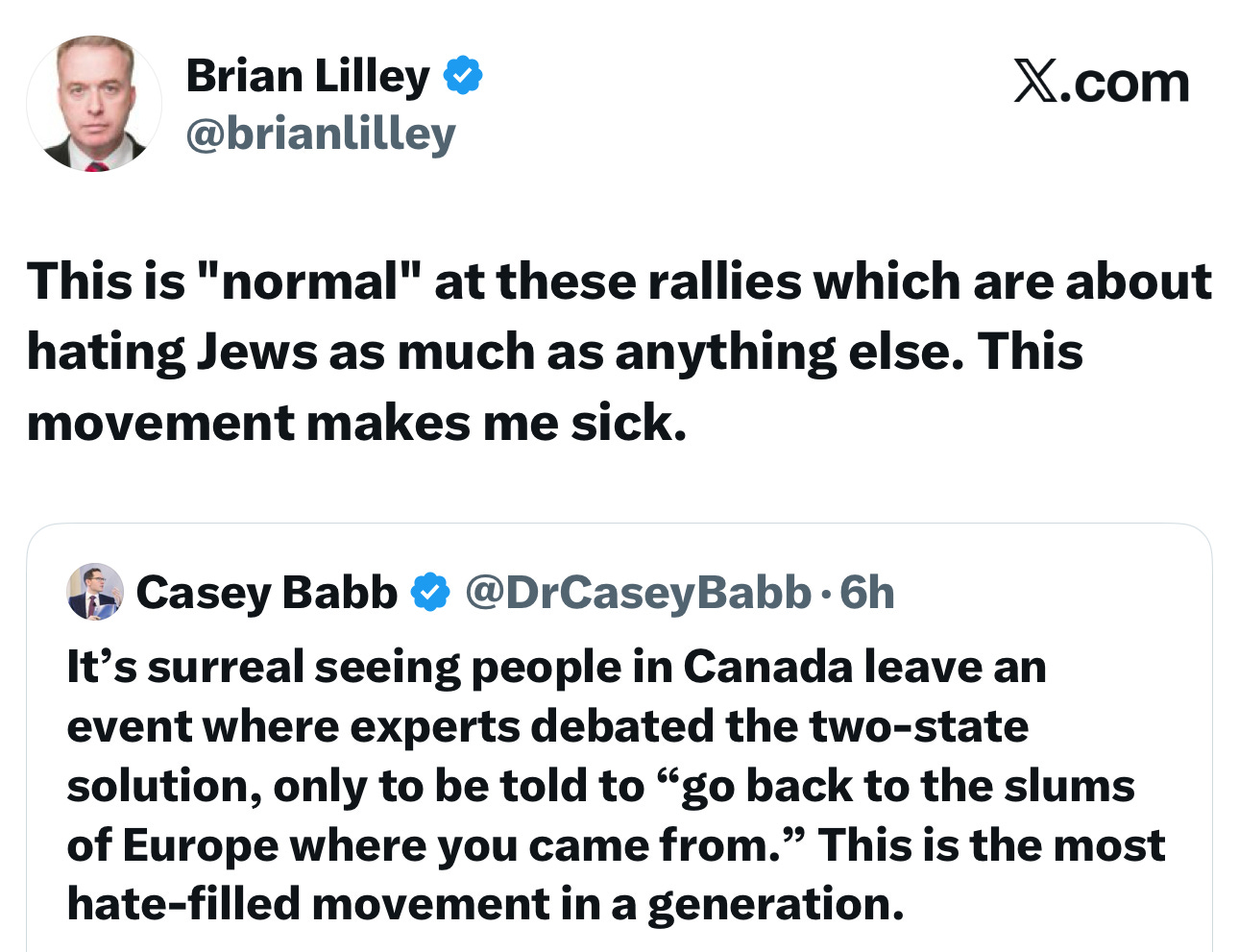
Look at the above screenshot of Brian Lilley’s X post. Where does this come from?
The late Rabbi Jonathan Sacks likened antisemitism to a continually mutating virus.
Where does this iteration of antisemitism we now see come from? Did progressives envision when they cultivated their identity and race-based political and ethical culture that it would tail spin out of control and into some radicalising force that turns the brains of young people, and also transforms older people into full blown extremists? Because, yes, it meets the definition of extreme behaviour to stand on the street outside the Munk Debates on the Two State Solution with your made in China Arab Revolt flag and keffiyeh or shemagh shouting at those whom you think look Jewish “go back to the slums of Europe where you came from.”
When did Canadians decide they wanted a national culture centred on hatred? When did we decide to give ourselves permission to tell each other to get out of the country, as though we could treat the country we share with millions of others as our personal property? What if all this progressive focus on “fighting hate” means we stared into the abyss so long that we became the abyss, and internalised the abysmal monsters we projected into the abyss? How much of what we attribute to others do we project onto those others?

How did we get to this point? Has social media echo chambers rendered us intolerant to disagreement? Did we decide that, when a heretical thinker disagrees on controversial issue, this means we label them as hateful? How does that bring us closer to unity as a society and humanity? Did our need to designate a scapegoat for the ills of our society lead us here? Did our need to designate a scapegoat for historical wrongs lead us here? Did our need to allay our own guilt about a historical wrong by trying to cure that historical wrong lead us here? Why do we think we can pinpoint a singular originating cause for the ills of society? Why do we think we can cure history? Why do we continue to ignore the mimetic forces at play in our society? How do mimesis and identity culture interact?
What is identity? How do we develop identity? How much control do we have over our preferences, as individuals? How do our preferences shape our identity? I think the Sprout video (above) makes a valid point. I think René Girard observed the human condition aptly — we have physical needs, which embody our desire for utility of objects, and we have metaphysical needs, which embody our craving for identity. We often choose objects to satiate our physical needs in ways that will serve our metaphysical needs, ie to serve our identity. Mimesis leads us to the preferences we choose, it shapes our relationship with objects and it shapes our ideas about objects.
Just think of marketing and the influence advertising has upon the choices we make in our daily lives. Well, with the advent of social media, think about how marketing and branding of concepts and ideas and ideologies has come to impact the choices we make and the ways we navigate our relationships. What I refer to as Wokerati or Woketopia or Woko Haram or the Wokifada has a very strong mimetic element at its core. Memetic forces power group think movements. They override the individualistic element that exists in any human. In this light, truth and falsehood, good and bad, love and hate— they all emerge from the mimetic machinations of group dynamics.
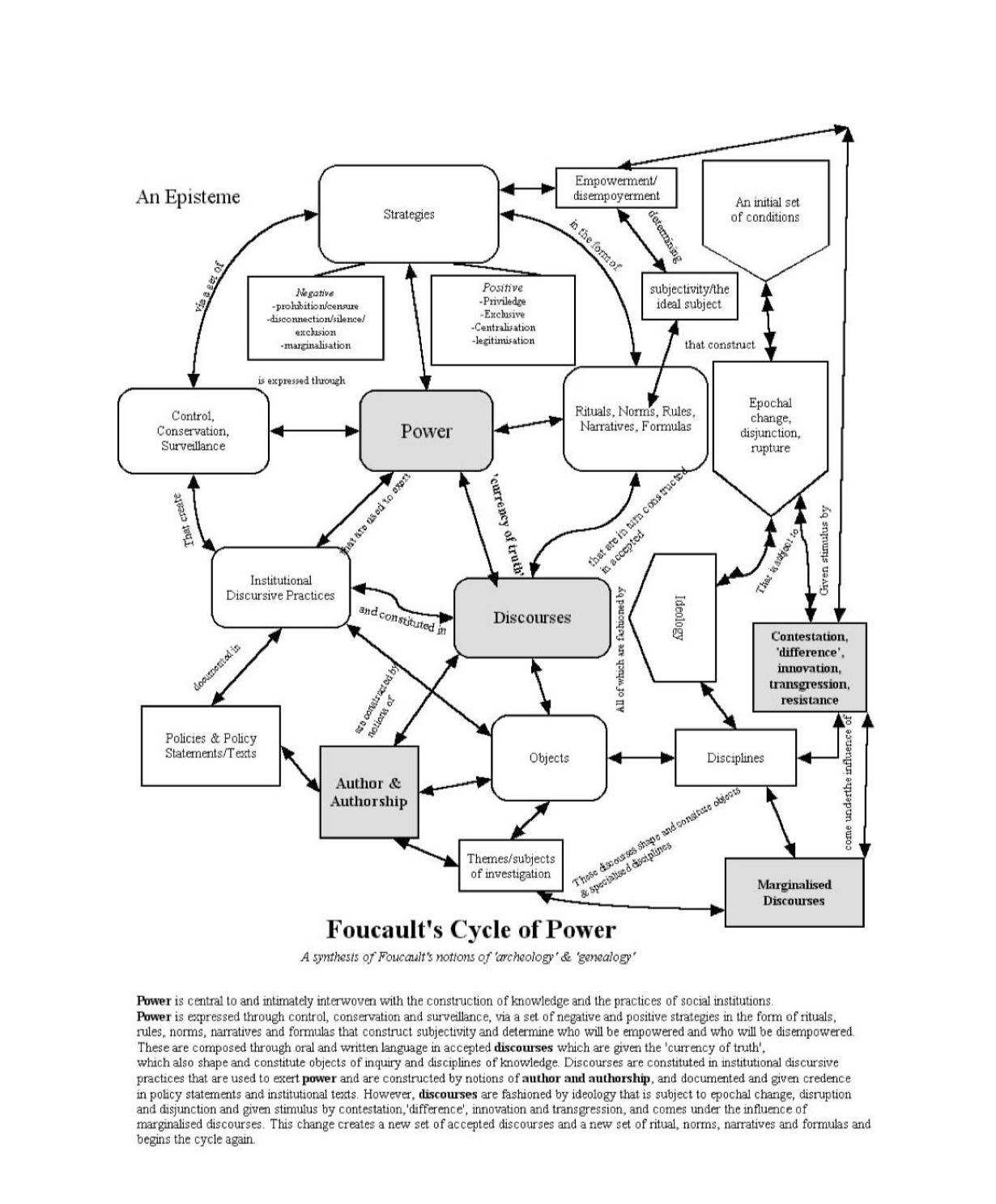
When Foucault said and wrote that power produces and sustains truth, meaning that truth changes over time and across humanity, he had a point, didn’t he? Many conservatives have made Foucault a scapegoat for Wokeness, when he really only committed the offense of observing the pattern of the interplay between power and truth in society that produced Wokeness. Mimetic theory leads us to the fluidity of truth because of power posturing!
“Power is central to and intimately interwoven with the construction of knowledge and the practices of social institutions. Power is expressed through control, conservation and surveillance, via a set of negative and positive strategies in the form of rituals, rules, norms, narratives and formulas that construct subjectivity and determine who will be empowered and who will be disempowered. These are composed through oral and written language in accepted discourses which are given the ‘currency of truth’, which also shape and constitute objects of inquiry and disciplines of knowledge. Discourses are constituted in institutional discursive practices that are used to exert power and are constructed by notions of author and authorship, and documented and given credence in policy statements and institutional texts. However, discourses are fashioned by ideology that is subject to epochal change, disruption and disjunction and given stimulus by contestation, ‘difference’, innovation and transgression, and comes under the influence of marginalised discourses.” — Edwin Creely
We do not need hate legislation. We do not need online harms legislation. We do not need bloated and bougie human rights commissions to police and adjudicate morality in society. That political machinery exists to surveil Canadians, not to protect or help them overcome “hate,” “racism,” or any other thought crime. These surveillance systems serve the panopticonomy.
I enjoyed this post, Roxanne, and basically agree with your conclusions. But allow me to probe your analysis a little some, please, and make sure I understand the potential implications.
For the distinction you make between mimetic behavior and emotivism - is the worry there that, well, potentially anyone could be charged with a 'hate crime' under this law, and based on their reflexive (even subconscious?) imitation of an associated affinity group's beliefs and convictions? And when real and actual hate - so much as it can theoretically be prosecuted - is probably more emotive and ambiguous in character?
I get the sense that the incoherence here may lie in the final indeterminacy (or unknowability) of expressive motive and intention, perhaps. Would you agree with such an assertion? And, if that seems about right - i.e., that the law is therefore and finally misguided - what are the potential tradeoffs for striking it on grounds of the same incoherence?
That is to say, do we possibly see more public violence and bigotry as an outcome-based account of such a move? And, if so, is this possibly just the (regrettable) price to be paid for us living in free and pluralistic societies?
I'm sitting here in the U.S., obviously, looking in from the outside to Canada. But, of course, we have this same type of public policy debate all the time here, too. It's hyper-relevant in both our national contexts.
I'm grateful in advance for your time.
cheers,
Luke