

Stringfellow: The Word As An Ethic For Resistance to Death
notes from An Ethic for Christians and Other Aliens in a Strange Land, part 3

“Demonic refers to death comprehended as a moral reality … Death rules … all … principalities and powers of this world … Death assumes … the … role of G-d … Death … incarnates [itself] in the traditions … of all … powers … Death as a moral power means death as a social purpose.” (pp. 67-70)
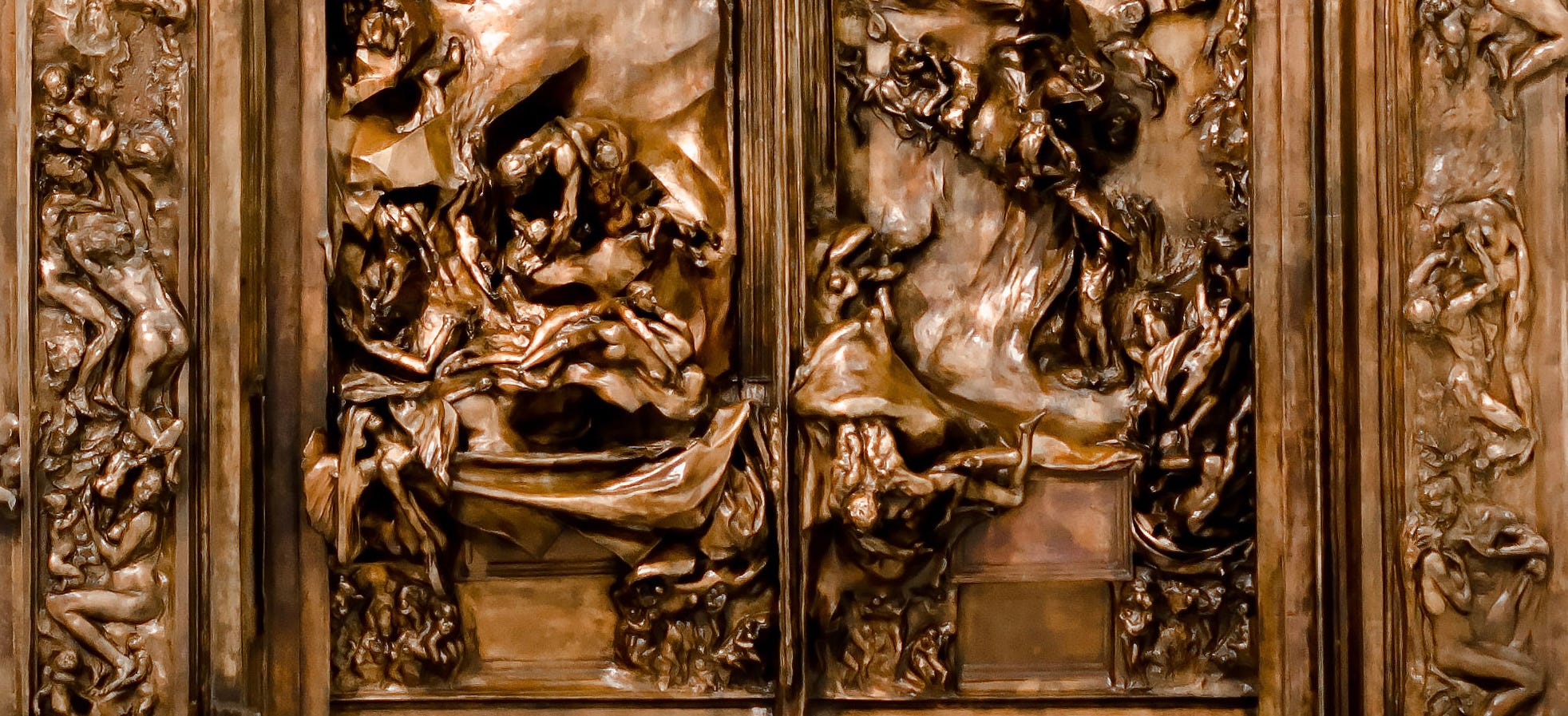
📸: a detailed view of The Gates of Hell at the Musée Rodin, Paris
In his book An Ethic for Christians and Other Aliens in a Strange Land, Stringfellow describes demonic power as death incarnated into institutions, systems, ideologies and other vehicles for the wielding and transacting of power in society, which he calls principalities. These principalities have modes of operation in Creation—stratagems. In part 2 I wrote about the strategems of demonic principalities. Today, in the third and final part of the Stringfellow series, I’ll discuss the Christian ethic of resistance to the demonic principalities.
The Christian ethic guiding resistance to demonic principalities has two prongs:
Live humanly by resisting death —this refers to working quietly and audaciously to disrupt and resist death incarnate,
Take recourse in Biblical study — this entails closely studying the Bible to grasp the essential tactics of living a resistance to death incarnate.
To choose not to resist means choosing certain death, the death of conscience, and hence, of sanity and, ultimately, of one’s own humanity. For he that will save his life, shall lose it: and he that shall lose his life for my sake, shall find it, said Jesus in Matthew 16:25. That passage embodies an essential ethic of resistance to death incarnate. Stringfellow points out the impotency of revolutionary causes and the falseness of the hope they stir and inspire. Ultimately anything born out of the ethic of death incarnate will spread more death. The Christian ethic renders the Christian an alien in Babylon.
Christians realize an inherent inefficacy in classical revolution because of its reliance upon the very same moral authority as the regime or system which it threatens to overthrow and succeed death-and thus, they resist that. Revolutionary sanctions of death cannot overcome the social purpose of death in any status quo. In any revolution, the means of death cannot transcend death, much less defeat or destroy death. At the most, it can alter the guise of death or make death appear more attractive … The issue here is the vitality of the moral power of death in the origins of revolution, and not merely one of distortion or abandonment or compromise of initial revolutionary aims, nor one of subsequent counterrevolutionary events undoing a splendid revolutionary charter (p. 123).
Ultimately, the history of warfare provides us with footnotes regarding the reign of death over the revolutions of nations and other principalities (p. 125). Can Christians ever endorse resorting to violence? No. And yet The Fall of Creation has rendered violence a norm within Creation.
Violence describes all of the multifarious, inverted, bro-ken, distorted and ruptured relationships characteristic of the present history of this world. Violence is the undoing of Creation. Violence is the moral confusion and practical chaos which, so long as time lasts, disrupts and displaces the truth and peace of Creation, which the Bible denominates as the Fall. Violence is the reign of death in this world and violence is the name of all and any of the works of death (p. 127).
Note: In the chapter called Christian Resistance to Death, Stringfellow mentions Bonhoeffer and implies Bonhoeffer had some involvement in the assassination plot against Hitler. Most Bonhoeffer scholars reject any suggestion that he wanted to kill Hitler. Despite evidence that exists to the debunk the claim that Bonhoeffer knew about and condoned the plot to kill Hitler, that story persists to this day. There is no ‘Bonhoeffer Dilemma’, only a false narrative about Bonhoeffer.
Interestingly, Stringfellow saw any hope as false and delusional “without or apart from … confrontation with the power of death” (p. 138). Facing and engaging the struggle of resisting the power of death defines humanity and the human condition, and through our “reliance on Grace in the face of death”, we find Hope (p. 138). Stringfellow spends some time in the last chapter of this book discussing the gifts of the Holy Spirit and their significance for Christian resistance to death. The gifts contribute to the “restoration and renewal of human life in society” (p. 144). He mentions discernment as vital to any Christian alien living in Babylon, his metaphor for a Fallen nation state principality.
Bible study—is the most essential nurture of contemporary biblical people while they are involved, patiently and resiliently, in the common affairs of the world. Biblical living means, concretely, practicing the powers of discernment, variously perceiving and exposing the moral presence of death incarnate in the principalities and powers and otherwise. And biblical living means, moreover, utilizing the diverse and particular charismatic gifts as the ethics and tactics of resistance to the power of death in the assurance that these gifts are in their use profoundly, radically, triumphantly humanizing.
Biblical living discloses that the ethical is sacramental, not moralistic or pietistic or religious … biblical people live in vigilance and consolation … Biblical living is watchful for that consummation but does not strive to undo the power of death, knowing that death is already undone and is in no way whatever to be feared and worshiped. Biblical living originates in this consolation (pp. 151-2).
So, what does Christian resistance to death look like, practically?
Watch vigilantly
Practise discernment
Involve yourself in the world patiently and resiliently
Take consolation in Jesus having conquered death
Perceive and expose the moral presence of death incarnate
Refuse to worship or glorify death
NOTE :: Links to other parts of the Stringfellow series: Part 1, Part 2.