

Stringfellow: The Stratagems of the Demonic
notes from An Ethic for Christians and Other Aliens in a Strange Land, part 2

“Demonic refers to death comprehended as a moral reality … Death rules … all … principalities and powers of this world … Death assumes … the … role of G-d … Death … incarnates [itself] in the traditions … of all … powers … Death as a moral power means death as a social purpose.” (pp. 67-70)
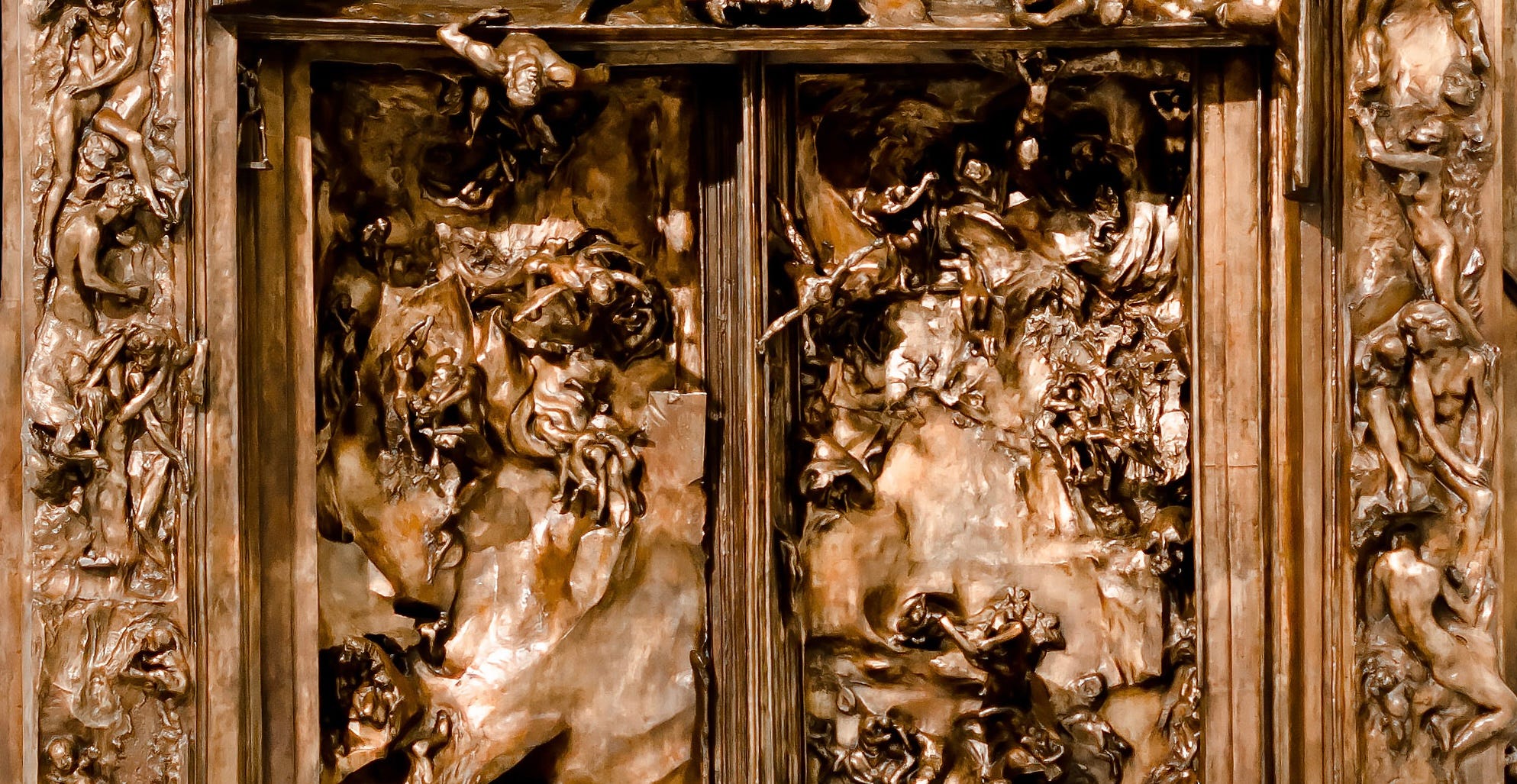
📸: a detailed view of The Gates of Hell at the Musée Rodin, Paris
In his book An Ethic for Christians and Other Aliens in a Strange Land, Stringfellow describes demonic power as death incarnated into institutions, systems, ideologies and other vehicles for the wielding and transacting of power in society, which he calls principalities. These principalities have modes of operation in Creation which Stringfellow calls stratagems. In part 2 of this series on Stringfellow and the Demonic, I’ll describe the stratagems of the demonic principalities.
First, let’s review the concept of the demonic principality. In a 2009 post in his blog Experimental Theology Richard Beck writes, about the supra-human nature of an institution.
“Every organization is made up of humans who make its decisions and are responsible for its success or failure, but these institutions tend to have a supra-human quality. Although created and staffed by humans, decisions are not made so much by people as for them, out of the logic of institutional life itself. And because the institution usually antedates and outlasts its employees, it develops and imposes a set of traditions, expectations, beliefs, and values on everyone in its employ. Usually unspoken, unacknowledged, and even unknown, this invisible, transcendent network of determinants constrains behavior far more rigidly than any printed set of rules could ever do.” —Richard Beck, Notes on Demons & the Powers: Part 8, The Inner Aspect of Material Manifestations of Power, in Experimental Theology, December 9, 2009
So, we can describe institutions as invisible entities. Or perhaps we can describe them as visible entities powered by an invisible spirit. Reader, remember that what we see only represents a fraction of the totality of what is. In fact, Paul wants the Colossians about this in verse 8 of chapter 2, when he writes, See to it that no one takes you captive through hollow and deceptive philosophy, which depends on human tradition and the elemental spiritual forces[a] of this world rather than on Christ. In Biblical cosmology, what happens on earth mirrors what happens in heaven. The seen world corresponds to a vast unseen world. How have we lost sight of our world in the cultural shift from an enchanted to a disenchanted worldview? Has the demonic become replaced with sickness? How does that serve us, other than delude us into thinking we have more control over principalities than we actually do.
What are the ways of the demonic?
Denial of truth — Foucault wrote extensively about truth as a function of power — he observed that this thing we call truth gets decided in the discourse of the powerful and influential and their power principalities. Essentially, Stringfellow echoes this thinking. Readers know well the phenomenon of truth manufactured to serve an ideological purpose, and to empower the ideologically captured institutions we rely on to govern, which really means to distribute power.
A myriad of examples exist in progressive dominated Canadian political discourse. The Gender ideology discourse, the Canadian Anti-Hate Network, the treatment of the issue of Chinese Communist Party interference at all levels of government—to name but a few examples of the upending of truth to the point of gaslighting. Pretending that GPR can identify human remains and refusing to excavate remains, and then accusing of hate and denialism anyone who questions the issue of the “215 mass graves of children” that have never been proven because they don’t exist, and demands forensic evidence remains possibly the wildest and most gaslighting and gratuitous example of the denial of truth in Canada.
A rudimentary claim with which the principalities confront and subvert persons is that truth in the sense of eventful and factual matter does not exist. In the place of truth and appropriating the name of truth are data engineered and manufactured, programed and propagated by the princi-pality. The truth is usurped and displaced by a self-serving version of events or facts, with whatever selectivity, dis-tortion, falsehood, manipulation, exaggeration, evasion, concoction necessary to maintain the image or enhance the survival or multiply the coercive capacities of the princi-pality. Instead of truth as that may be disclosed empirically, the principality furnishes a story fabricated and prefabricated to suit institutional or ideological or similar vested interests (p. 98).
Doublespeak and overtalk — Orwell coined the term doublespeak, referring to the ways in which principalities obfuscate truth through the use of coded phrases, euphemisms, and hyperbole. By overtalk, Stringfellow means the practise of repeating the hyperbolic, euphemistic, untruthful narrative. The human mind and psyche will prioritise familiarity over fact. Marketing preys on us all, exerting this knowledge as a power over us, with a view to manipulating us into thinking or believing or supporting a position. Again, gender ideology provides the best example of the doublespeak stratagem.
The discourse around fighting hatred, around anti racism, and around the obsession with the misuse of the word genocide whilst ignoring the horrors of MAiD and the failed drug policy in Canada—all serve as examples of doublespeak and overtalk. The discourse on the “215 mass graves of children” provides a good example of overtalk—the unsubstantiated claim made repeatedly despite not remains ever being found has manipulated many Canadians into thinking that mass graves of indigenous children exist. The human mind gives priority to familiarity over fact, and propagandists know that, and have known that since WW2.
The preemption of truth with prefabricated, fictionalized versions of facts and events and the usurpation of truth by propaganda and official lies are stratagems of the demonic powers much facilitated by other language contortions or abuses which the principalities and authorities foster. These include heavy euphemism and coded phrases, the inversion of definitions, jargon, hyperbole, misnomer, slogan, argot, shibboleth, cliché. The powers enthrall, delude, and enslave human beings by estopping comprehension with “double-speak,” as Orwell named it. Orwell’s prototype of the phenomenon of doublespeak declares “war is peace” (p. 100)
Secrecy and boasts of experience — Secrecy in the political breeds an arrogant and dehumanising paternalism, it creates a power disparity, when principalities hoard knowledge, knowledge becomes power over others. Frequently citizens hear about how they cannot know vital goings on about their own city, province, country. Those leaders whom we’ve elected to serve us have relegated us to a child like status. The notion of expertise means we don’t know any better, we need the experts to conduct governance in secret to protect us.
In BC the secret deals David Eby has chosen to make with First Nations, as opposed to engaging the existing transparent treaty negotiations process, provides a good example of secrecy. Reconciliation cannot take place because of secret deals that happen without public input, yet paid for with public funds. It’s all a bit cynical when we have unelected officials and supposed “knowledge keepers” governing British Columbians.
Surveillance and harassment — We live in the panopticonomy, the beginning of which Stringfellow saw in development. We rarely stop and think of all the ways principalities, led by the state, monitor and surveil us. When you leave your home to go anywhere in your town or city, CCTV cameras populate your route, so much so that you probably have long stopped seeing them. GPS tracking means your mobile phone functions as a tracking device, letting all know your physical location. Surveillance culture creates another cultural layer of power disparity.
Remember the shocking revelations of Edward Snowden? How much data do principalities hoard in each of us? For instance, what do the police know about you? How much privacy do we have, really, considering the burden of the data culture that defines our lives? Why did Mary and Joseph need to travel to Bethlehem? For a census. Why did the Romans need to take a census of Jews? To harass them, to track and tax them.
In Canada we have an authoritarian regime of professional regulatory bodies which punish and persecute licensed professionals for social media posts they’ve made or even for legal associations to political viewpoints and groups they have made in their lives.
Exaggeration and deception — I often write about rage farming and outrage baiting. I have frequently written about the reaction to the Cowichan ruling by describing the hysteria that characterises the conservative discourse. In reading Stringfellow, I can see that these things annoy and irritate me because of the deceit that they represent. Ultimately, it’s clickbait, its attention seeking, its grandstanding. It often emanates from or begets self aggrandisement. Again, marketing employs this stratagem to such a degree that we no longer see it, that we’ve normalised it. Goebbels employed exaggeration, McCarthy also did.
The Woke left and Woke right of present day have similar strategies they employ to influence popular opinion, and to create a more controllable society. The Woke left would have you think our society has a horrible plague of racism and hatred. They promote this narrative to justify the control and censorship they wish to impose on us. The Woke right would have you think our society has a horrible plague of communist corruption and globalist cabal that’s taking away everything you have worked for, that will take away your home. They promote this narrative in order to justify their claim that only they can save you from this corruption.
In American merchandising this wantonness has foisted a huge quantity and a startling array of phony, worthless, dangerous goods and services upon purchasers. What may be more significant, such commercial deception has been so common, so widespread, and practiced for such a long time that when the same techniques are politically appropriated human resistance has already been made pliable (p. 103).
Cursing and conjuring — I’ve written about scapegoating and memetic theory. By cursing and conjuring Stringfellow conveys the same idea. The principalities vilify dissenting voices. They designate the dissenting and resistant as scapegoats. This sets up any justification for conjuring up persecution against these dissenting voices. We can view Bonhoeffer as an example of cursing and conjuring. The Nazis arrested him for dodging the draft, and ultimately executed him for his association with the Abwehr, which plotted against and sought to assassinate Hitler. The conjuring up of Guilt by Association condemned Bonhoeffer to death, and has condemned him to this day as a part of the core group of the Abwehr which sought to kill Hitler. No serious Bonhoeffer scholar believes Bonhoeffer wanted to or tried to kill Hitler, or even knew about the assassination plot.
I’ve mentioned the victims of persecution of free expression and though crimes above. I’ve also mentioned the invoking of hate and denialism against those who harbour and express skepticism about the story of the 215 graves. It’s all about protecting identities and ideas from scrutiny, at the expense of those who reveal the dishonesty and corruption with the principalities in question.
Usurpation and absorption — In an increasingly authoritarian culture, the nation becomes absorbed by the principality of the state. We demonic powers usurp the society that makes up the nation for its own ends. The state’s role as prosecutor transforms into persecution, thus creating political prisoners out of dissenters and resistance activists.
In Canada we have seen many examples of state and regulatory principalities persecuting dissenters for wrong-think, or for daring to challenge or oppose the state in a sacred realm. Amy Hamm, Chris Barber, Tamara Lich come to mind as examples of this stratagem of the demonic in Canada.
Diversion and demoralisation — The sacrificing of scapegoats for the principality, such as in the case of Amy Hamm, serves the purpose of demoralisation. We frequently describe this as making an example. It serves to incentivise others not to resist, not to take a bold stance and speak the factual unpopular truth.
The mindless nattering of celebrity gossip á la Hollywood culture serves as a diversion, to draw our attention away from the important and necessary issues, to draw us to expend our energy on the unimportant. This stratagem attacks the core of comprehension, it upends sanity, it distorts conscience.
There are numberless other diversions convenient to the demonic powers, some of which may be thought of as dividends which accrue when other ploys are at work. The relentlessness of multifarious babel in America, for example, has wrought a fatigue both visceral and intellectual in millions upon millions of Americans. By now truly demoralized, they suffer no conscience and they risk no action. Their human interest in living is narrowed to meager subsist-ing; their hope for life is no more than avoiding involvement with other humans and a desire that no one will bother them. They have lost any expectations for society; they have no stamina left for confronting the principalities; they are reduced to docility, lassitude, torpor, profound apathy, and default. The demoralization of human beings in this fashion greatly conveniences the totalitarianism of the demonic powers since the need to resort to persecutions or imprisonments is obviated, as the people are already morally captive (p. 106).
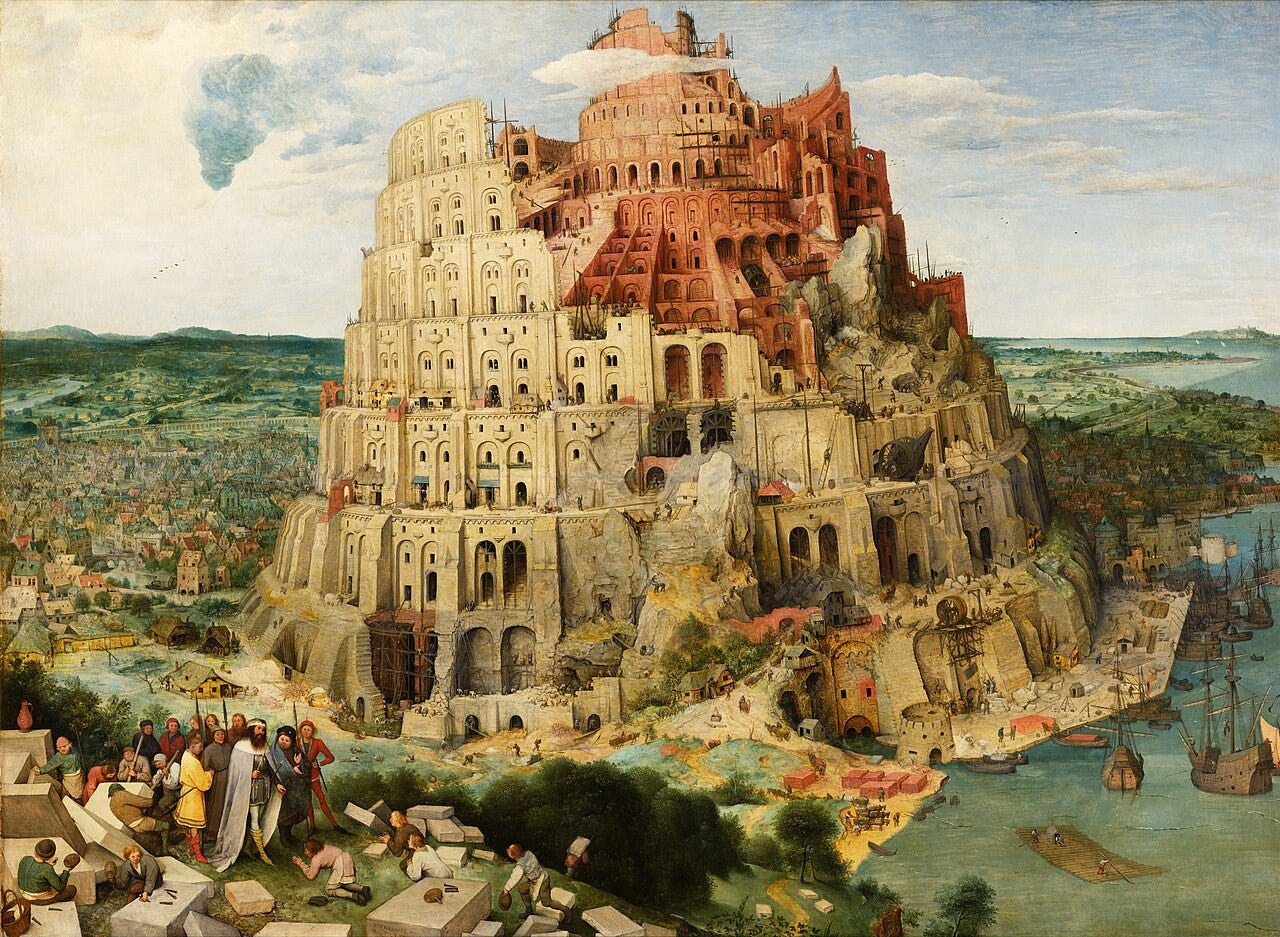
artwork :: The Tower of Babel by Pieter Bruegel the Elder, 1563
Babel means the inversion of language, verbal inflation, libel, rumor, euphemism and coded phrases, rhetorical wantonness, redundancy, hyperbole, such profusion in speech and sound that comprehension is impaired, nonsense, sophistry, jargon, noise, incoherence, a chaos of voices and tongues, falsehood, blasphemy. And, in all of this, babel means violence (p. 106).
In part 3, I’ll discuss the Christian ethic of resistance to the demonic, as outlined and described by Stringfellow in his book. You can purchase Stringfellow’s An Ethic for Christians in a Strange Land, on Amazon.
NOTE :: Links to other parts of the Stringfellow series: Part 1, Part 3.
Something of a follow-up; lots of food for thought here, even if it's maybe too easy to go off the rails and into the weeds. But this bit in particular:
BH: Death as a moral power means death as a social purpose.” (pp. 67-70)
Reminds me of reading a description of a bee colony, of how the bees therein dealt with the bodies of the ones that died: unceremoniously -- though maybe the author wasn't looking closely enough -- shoving the dead bees out the hive, off the edge of the board on which the hive was resting: "bring out your dead" and all that.
Nature of the beast, of the species. Moot where the souls reside -- in the bodies, just passing through, no existence outside of it? Or in the tribe, in the species, or in the long line from creation -- spark from Jehovah to Adam?
> "Every organization is made up of humans who make its decisions and are responsible for its success or failure, but these institutions tend to have a supra-human quality."
"What rough beast slouches its way towards Bethlehem awaiting its hour to be born?" Apologies to Yeats if I've mangled his classic lines. Though, in a note from our sponsors, those "supra-human qualities" might be deemed "emergent properties" which may or may not be antithetical to the best interests of those they were designed to serve. Golems, of one sort or another, can be useful servants but hazardous masters:
https://en.wikipedia.org/wiki/Emergence#Emergent_properties_and_processes
But, en passant, I wonder at this quote of yours, "the … role of G-d …". Was that "G-d" part of your source or your editing of it? In either case, seems a bit pretentious or doctrinaire -- "outright idolatry to put a name to the Deity!!". The horror!!
The word "God" is, arguably, just the name for a hypothesis, although something of a necessary one, notwithstanding Laplace's claims to the contrary. But that may depend on the context.
Though nice to see the painting of The Tower of Babel there at the end -- a durable and useful parable that I've had reason to use myself:
https://medium.com/@steersmann/the-imperative-of-categories-874154213e42