

William Stringfellow and the Demonic
notes from An Ethic for Christians and Other Aliens in a Strange Land, part 1

“Demonic refers to death comprehended as a moral reality … Death rules … all … principalities and powers of this world … Death assumes … the … role of G-d … Death … incarnates [itself] in the traditions … of all … powers … Death as a moral power means death as a social purpose.” (pp. 67-70)
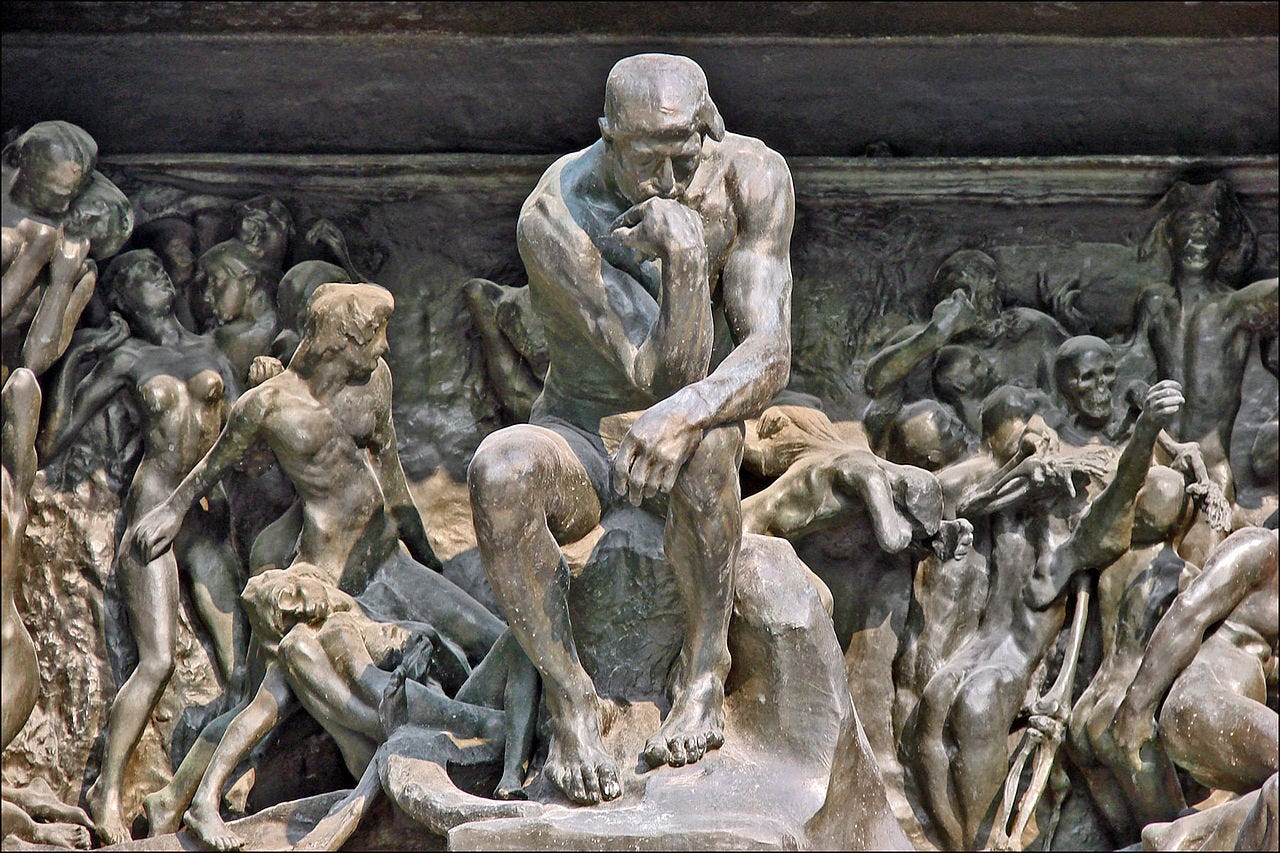
📸: The Thinker in The Gates of Hell at the Musée Rodin, Paris
In his book An Ethic for Christians and Other Aliens in a Strange Land, Stringfellow describes demonic power as death incarnated into institutions, systems, ideologies and other vehicles for the wielding and transacting of power in society. Tension and strife characterises the relationship between humans and these principalities, owing to “the alienation of the whole of Creation from G-d” (p. 76) as a result of the Fall, resulting in the fracturing of relationships between humans and other creatures, principalities counting amongst those creatures. Rather than winged monstrous creatures, for Stringfellow the word demonic refers to abstract forces and power structures that wield power and shape discourse, culture and opinion.
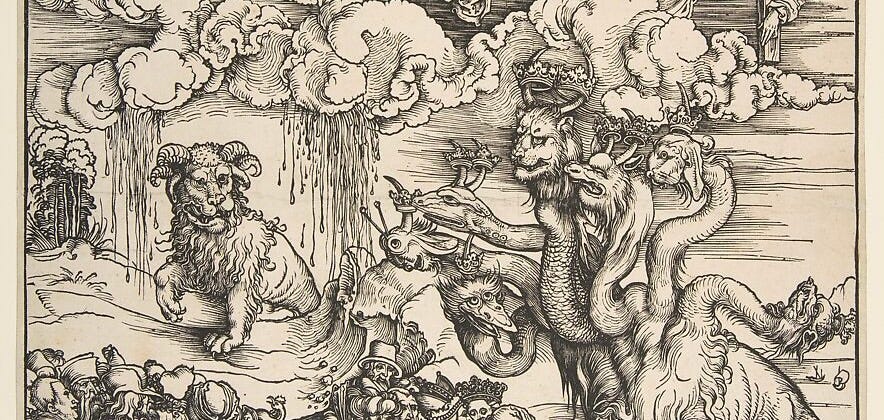
artwork: Detail from Albrecht Dürer, 1511, The Beast with the Seven Heads and the Beast with Lamb's Horns, The Met Museum
Stringfellow reminds his reader that the Biblical categorises principalities as legion “…in species, variety, number, and name,” (p. 77), citing passages in Luke, Galatians, Ephesians, Colossians as supporting his claim. In the story of the Gadarene demonaic, the demon identifies itself as legion, meaning a vast multitude functioning and acting under a single command. In Galatians 4:3, Paul refers to humans as enslaved under the elements of the world. In Ephesians 6:12, Paul writes about wrestling the darknesses of the world, specifically its authorities and rulers—embodiments of the spiritual powers of evil, death incarnate. In Colossians 2:10-23, Paul writes about shadows of spirituality, and describes empty practises and edicts which deceive and ultimately only gratify the self and draw the individual away from Christ.
Humans don’t see principalities as creatures, and so we discount their existence as autonomous entities with particular personalities and modes of being. The fallen nature of the world means that principalities exist in chaos, creating confusion and division and fuelling conflict. We delude ourselves into thinking that we create and control institutions and other principalities, we overestimate our control over systems and institutions of the world, and we cheat ourselves and empower the demonic elements by denying the existence of the demonic. Institutions do take on a life and personality of their own. In fact, our own laws designate corporations as persons!
Readers may remember Joel Bakan’s book The Corporation, in which “…Bakan contends that the corporation is created by law to function much like a psychopathic personality whose destructive behavior, if left unchecked, leads to scandal and ruin” (Joel Bakan [dot] com). Look at how algorithms have given birth of entities which shape our political world. Reader, do you honestly think humanity still has any control over these algorithms that power social media platforms? Whatever gives you that idea?! Scientists and others have asked whether algorithms and AI could become sociopaths. In a Forbes article from 2021, Robert Zafft asked if, through algorithms and AI, we have unwittingly unleaded a system of psychopathy that will rule us. In a 2018 Aeon article, Thomas T. Hills wrote about sociopathic algorithms.
“Social media is a writhing nest of human bias and hatred. Algorithms that spend time on social media sites rapidly become bigots. These algorithms are biased against male nurses and female engineers. They will view issues such as immigration and minority rights in ways that don’t stand up to investigation. Given half a chance, we should expect algorithms to treat people as unfairly as people treat each other. But algorithms are by construction overconfident, with no sense of their own infallibility. Unless they are trained to do so, they have no reason to question their incompetence (much like people).” — Thomas T Hills, Does My Algorithm Have a Mental Health Problem, Aeon[dot]co
We lie to ourselves if we think that, in a Fallen world, the rest of Creation has escaped the effects of that Fallenness which gripped us. We delude ourselves if we think we have control over principalities such as AI and social media algorithms. We reveal our vanity, in thinking that we simply need to have enough strength in order have dominion over the institutions and other principalities that propel and power our society. “Pretending autonomy from G-d, these creatures are autonomous from human control” (p. 82).
In part 2, I’ll describe the “ stratagems of demonic powers” which Stringfellow wrote about in his book. You’ll recognise many of these forces, because they’ve been deployed in our current culture and discourse. You can purchase Stringfellow’s An Ethic for Christians in a Strange Land, on Amazon.