

What are You Seeking?
a reflection on Brian Zahnd’s sermon for January 18th, 2026

What are you seeking? To where will your holy curiosity lead you? What’s your four o’clock in the afternoon moment with the Divine?
After the baptism of Jesus, Andrew and John follow Jesus after John the Baptist points Him out to his own disciples.
“What are you seeking,” asks Jesus. These are the first words we hear from the Word in the Gospel of John.
The baptism of Jesus foretells the resurrection of Christ. In the resurrection of Christ, the world arises. Jesus is the lion of Judah (lineage of David) and He is the lamb slain. Jesus doesn’t conquer as David did, He conquers as a lamb, He conquers through the incarnation.
Killing the bad guys perpetuates the badness. Jesus came to show us a different and better way.
What are you seeking? Seek and you will find.
What do you seek, though? Success? Fortune? Power? Peace? Unity? Joy? Tranquility?
Andrew and Simon and John say they want to be with Jesus. Curiosity led them to follow Him. What’s curiosity? Curiosity: a saving grace that prevents stalled spiritual development. Where are you staying, the disciples of John the Baptist ask Him. Come and see, He answers.
How do we come to know Jesus?
Through historical context? (No). We know Him by coming to Him in by faith. Through faith you can see and experience Christ for yourself. The disciples stayed all day, it was four o’clock in the afternoon. What did they talk about? Did they share a meal together? (Probably). Some of the most life changing moments take place over a shared meal. A meal is at the centre of our sacramental life — ritual.
Four o’clock — what’s it mean? Maybe nothing, maybe it’s the thing John never forgot. Because it changed his life, as a Divine encounter. Mystical experiences can occur at the most mundane time and place. Andrew and John followed their curiosity, they broke out of settled certitude. What’s a holy curiosity?
The whole of John the Theologian’s life becomes an aftershock from this moment of holy curiosity that happened at four o’clock in the afternoon when he was around 19 years old.
What will you do with your holy curiosity? Where will you find your four o’clock in the afternoon?
We are all responsible, there isn’t an us and them. There’s only us, we are it.
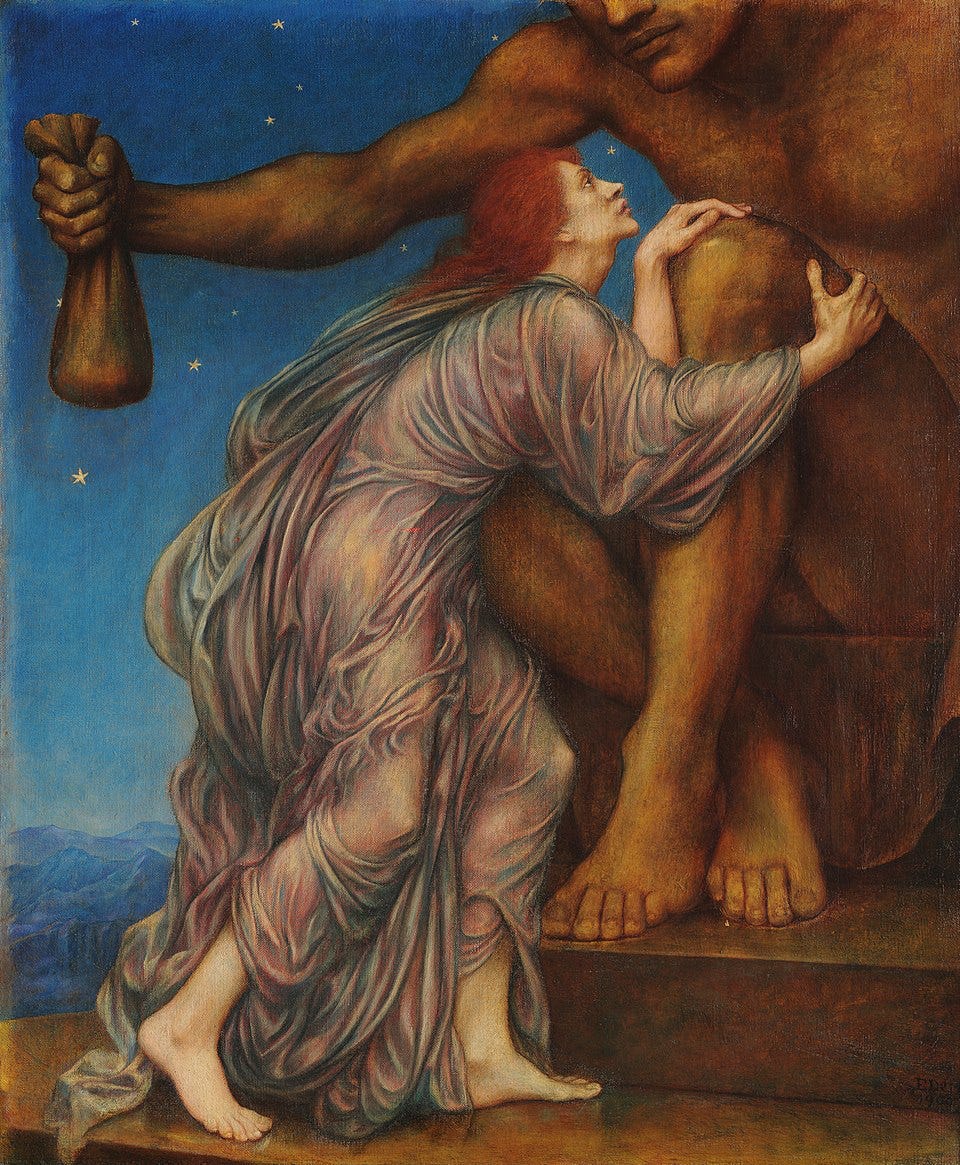
image: The Worship of Mammon, 1909, Evelyn De Morgan
We do not stop the bad by killing the “bad guys,” we only feed the bad. We do not serve goodness by designating those with whom we disagree as bad and wrong, we only feed the demons urging us on.
The English word diabolical comes from the “Greek word diaballein “to slander, attack,” literally “to throw across,” from dia “across, through” (see dia-) + ballein “to throw”.” We learn this important and uncomfortable lesson when we have a mystical experience in our four o’clocks in the afternoons.
The desire to throw slander and attack across humanity divides us as a humanity. Divisiveness is diabolical, ie. from the devil. The demonic seeks to destroy us from within—can you see how that’s happening now? Spend a moment on Facebook or X and feel the split amongst humans; It’s easy enough to forget that we are all humans, there isn’t a them, there’s only an us.
Go back and read my Stringfellow series and think about what you seek and what seeks you.
Think about the holy curiosity you may have done your damnedest to suppress within yourself.
Think about unfastening the manacles of the algorithm that’s enslaved humanity. Emancipate yourself.
Think about making space for your own four o’clock in the afternoon moment, like Andrew and John did.