

The Root of Jesse
sermon reflection for the Sunday of Advent, Brian Zahnd, Isaiah 11:1-10

This is the first of two sermon reflections for Sunday, December 7, 2025. In this essay I share my reflections about Brian Zahnd’s sermon, called The Root of Jesse, based on Isaiah 11:1-10.
Isaiah 11:1-10 :: The Branch From Jesse
11 A shoot will come up from the stump of Jesse;
from his roots a Branch will bear fruit.
2 The Spirit of the Lord will rest on him—
the Spirit of wisdom and of understanding,
the Spirit of counsel and of might,
the Spirit of the knowledge and fear of the Lord—
3 and he will delight in the fear of the Lord.
He will not judge by what he sees with his eyes,
or decide by what he hears with his ears;
4 but with righteousness he will judge the needy,
with justice he will give decisions for the poor of the earth.
He will strike the earth with the rod of his mouth;
with the breath of his lips he will slay the wicked.
5 Righteousness will be his belt
and faithfulness the sash around his waist.
6 The wolf will live with the lamb,
the leopard will lie down with the goat,
the calf and the lion and the yearling together;
and a little child will lead them.
7 The cow will feed with the bear,
their young will lie down together,
and the lion will eat straw like the ox.
8 The infant will play near the cobra’s den,
and the young child will put its hand into the viper’s nest.
9 They will neither harm nor destroy
on all my holy mountain,
for the earth will be filled with the knowledge of the Lord
as the waters cover the sea.
10 In that day the Root of Jesse will stand as a banner for the peoples; the nations will rally to him, and his resting place will be glorious.
The kingdom flowing from David’s line had its share of problematic kings. The son of Solomon (grandson of David) Rehoboam treated his subjects with cruelty and arrogance. The ten northern tribes (10) broke away and became Israel, the 2 remaining tribes, Judah and Benjamin, kept Jerusalem and the Jewish temple. In the time of the prophet Isaiah, the kings ruled a corrupt society. The rich exploited the poor—finding ways to keep the poor in debt, and then buying their property and making them (the poor) their serfs in the land they previously owned. Lion, wolf, leopard eat the lamb, the kid, and the yearling.
Isaiah has an oracle, ie a prophecy, of the sevenfold anointing on the root of justice. The seven qualities embodied in the Messiah include Spirit of the Lord, Spirit of wisdom, Spirit of understanding, Spirit of counsel, Spirit of might, Spirit of knowledge, Spirit of fear of the Lord. The root of Jesse will make decisions that serve the meek. The lion will lie down with the lamb—nor literally, obviously; it’s a poetic metaphor to describe the powerful living humanely with the less powerful, the vulnerable, and disadvantaged.
Did Isaiah think it would take 700 years for the root of Jesse to come? No, he likely didn’t. Maybe he went to his death wondering about the veracity of his prophecy? Prophets often don’t receive acknowledgement of their wisdom from their contemporaries—often they only received persecution. Isaiah pinned his hopes on Hezekiah, a good king and faithful to G-d, as the messiah of his prophecy.
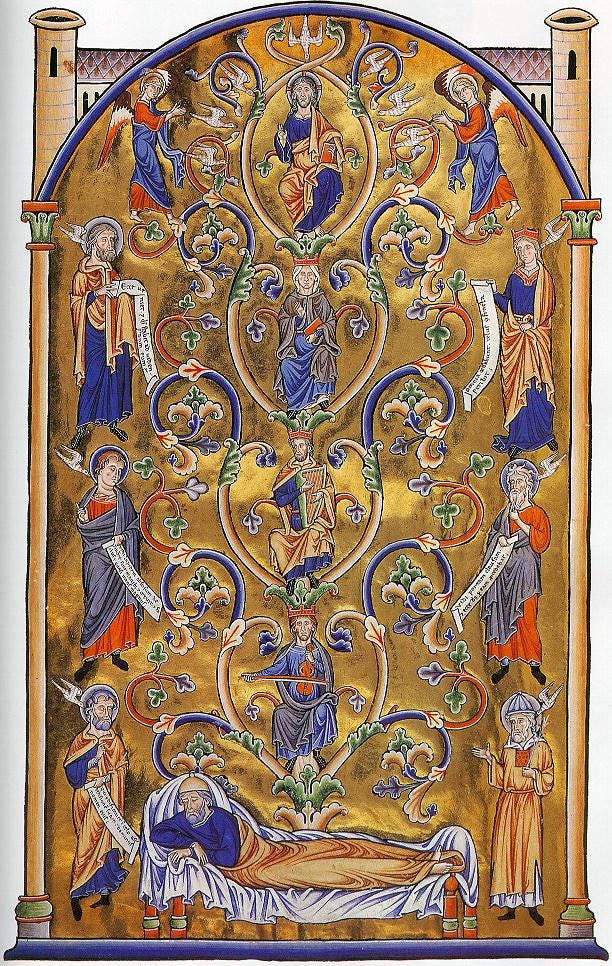
Matthew 1:1 provides a genealogy of Jesus. Through Christ, G-d keeps His covenant promise to Abraham and David. Jesus has a genealogy. He wasn’t beamed down from heaven in all glory, Jesus joined the human story by being born into it—He has a family tree.

The lineage of Jesus includes patriarchs, prophets, kings, villains, and the deeply flawed—all of it. Manasseh (a pretty bad dude) is in Jesus’s family tree! Look at the women in His genealogy, we know these five women—Tamar1, Rahab2, Ruth3, Bathsheba4, Mary5. Tamar pretends to be a prostitute and gets Judah to impregnate her. Rahab is a prostitute who saves the Israelite spies of Joshua from being persued and destroyed by the rulers of Jericho. Ruth, a Moabite, became Jesse’s grandmother. Bathsheba was a victim of David’s lust and his abuse of royal power, it’s not a stretch to say she was David’s rape victim.
Jesus comes from an imperfect family tree.
With the birth of Jesus something significant happens. Jesus reaches back to save all the rest that he descended from because they descend from Him. The Church of Nativity in the Holy Land has a 14 point star, (pictured above). Why, what’s the significance? Remember the genealogy in Matthew 1:17? Fourteen (14) generations x 3 = 42 generations from Abraham to Jesus; 3x14 =42 = 6x7. There’s the number seven again, as in the sevenfold anointing of the root of Jesse.
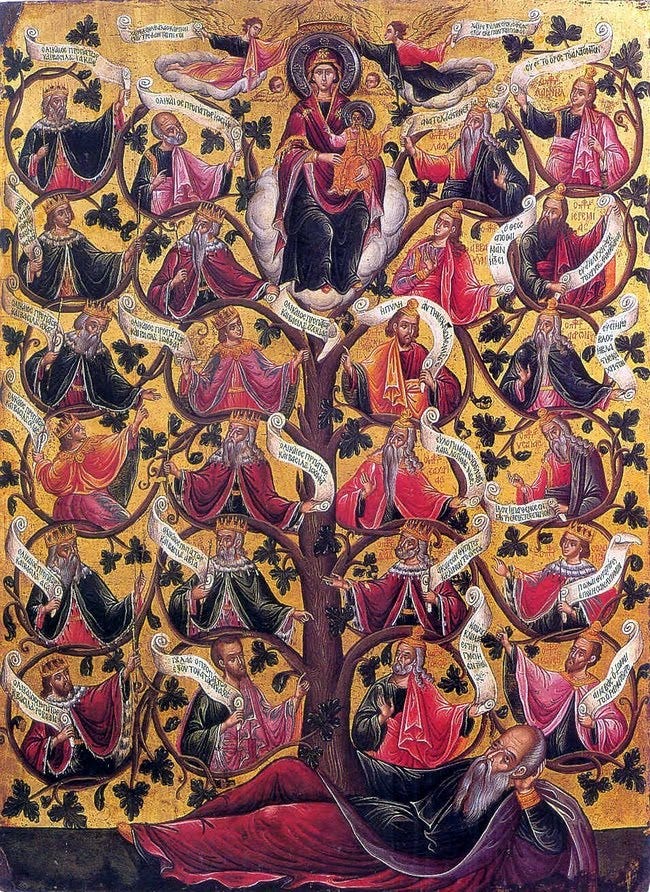
Jesus comes from the root of Jesse and Jesus is the root of Jesse. Yes, both.
In Romans 15:12, Paul wrote and again, Isaiah says, There shall be a root of Jesse, and he that shall rise to reign over the Gentiles; in him shall the Gentiles trust. In speaking of the root of Jesse, Paul references Isaiah 11:10. Remember, Isaiah would be the closest thing to a gospel that pre-gospel early church fathers had. Also remember Paul quoted the Septuagint, the Greek translation of the Hebrew Bible. The word גּוֹים goyim appears in the Hebrew text, it refers to Gentiles. In his ministry, Paul stressed the inclusion of the Gentiles in G-d’s salvation plan as written in the scriptures, so Gentiles could find their hope in Christ. In the next line, in Romans 15:13, Paul wrote now the God of hope fill you with all joy and peace in believing, that you may abound in hope, through the power of the Holy Spirit. Reader, we do not abound in hope through “positive thinking,” we abound in hope through power of Holy Spirit, who will give us an alternative imagination. We find hope in Jesus. Let’s abound in hope that leads to all joy and peace in Jesus.
“As Judah’s daughter-in-law, Judah believes she has killed two of his sons, and subjugates her so that she is unable to remarry. However, she ultimately tricks Judah into impregnating her and therefore secures her place in the family. She gives Judah two sons, and her story illustrates her loyalty and her willingness to be assertive and unconventional.” —Jewish Women’s Archive
“Before the Israelites cross the Jordan, Joshua sends men to scout out the land. Arriving in Jericho, they decide to spend the night at the house of the prostitute Rahab. When Jericho’s ruler tries to apprehend them, Rahab hides them and then helps them escape through the window, thus saving their lives. In return, she and her household are spared the destruction of Jericho and become part of the people Israel.” — Jewish Women’s Archive
Ruth is a Moabite woman who marries a Judean immigrant and when he dies, leaving her a childless widow in a strange culture, Ruth stays with her mother-in-law, Naomi. She remains loyal and devoted to Naomi, ensuring Naomi has enough food. Ruth pursues marriage to Boaz, and has a son, thus redeeming Naomi’s line. Ruth is the great grandmother of David.
Bathsheba was a married woman David spied bathing from his roof. Uriah, Bathsheba’s husband, was devoted to David, and was away at war. David seduces Bathsheba and gets her pregnant. He summons Uriah home to cover his tracks, but Uriah, ever loyal, refuses to leave the frontline. So David arranges to have Uriah killed so he can marry the widowed Bathsheba. A curse is put on David’s house and the first born dies. Bathsheba ensures that their second son, Solomon, reigns. — source is Jewish Women’s Archive
Mary said yes to the angel of the Lord, she agreed to bear the messiah, risking reputation to do G-d’s will. Mary was betrothed to Joseph and it was scandalous for a betrothed woman to get pregnant not from her betrothed.