

Mount Messiah
part 1 of the “waiting on Christmas with Isaiah” Advent Sermon Series by Brian Zahnd

This is the second of two sermon reflections for Sunday, November 30, 2025. In this essay I share my reflections of Brian Zahnd’s sermon, called Mount Messiah, based on Isaiah 2:2-4.

photo: Skellig Michael, Ireland, taken by Michael, via Unsplash
Isaiah 2:1 :: “This is a vision that Isaiah son of Amos saw concerning Judah and Jerusalem”
Hebrew literary prophets—Isaiah through Malichi—prophesied through poetry, they used profound imagination to convey their judgements and offering oracles of hope and salvation. The poetic and prophetic are related. Pose cannot contain the prophetic, the flat and linear nature of prose limits it as a medium. “When prose reaches the dead end of what can be said, that’s when the secret passage of poetry may appear. The poetic gives the possibility of speech to the previously ineffable.”
Hebrew literary prophets, (Isaiah through Malachi), didn’t embody pragmatism, nor utilitarianism, and neither did they embody political activism. No, they provided a conduit for the Holy Spirit, as Spirit inspired poets with prophetic imagination.
Isaiah, son of Amos, Isaiah of Jerusalem stands among the greatest poetic prophets. The Book of Isaiah contains 66 chapters, like the canon has 66 books.
Sections of the Book Isaiah: Pre exile 1-39 | Exile: 39-40 | Post exile: 40-66.
Our advent sermon series will focus on 1-39. Isaiah, son of Amos, began his career as a public poet prophet in 740 BC, during the life Homer, to give readers a cultural context. Isaiah’s public prophet career spanned approximately 60 years ago. The Book of Isaiah has so many messianic themes that the early Church fathers considered it as a kind of ‘fifth gospel.’ Matthew, Mark, Luke, and John didn’t appear until the 60s, 70s, 80s of the first century. Yes, the gospels didn’t exist until 40 years after the death of Jesus. Of New Testament canon, the Epistles of Paul came first, written in the 40s and 50s. So, the early Christians, led by early Church fathers, leaned heavily on Isaiah as anticipating Jesus. Isaiah served as THE gospel for the first generation of Christians, ie Jesus followers. The early Christians learned to see Isaiah as being about Jesus.
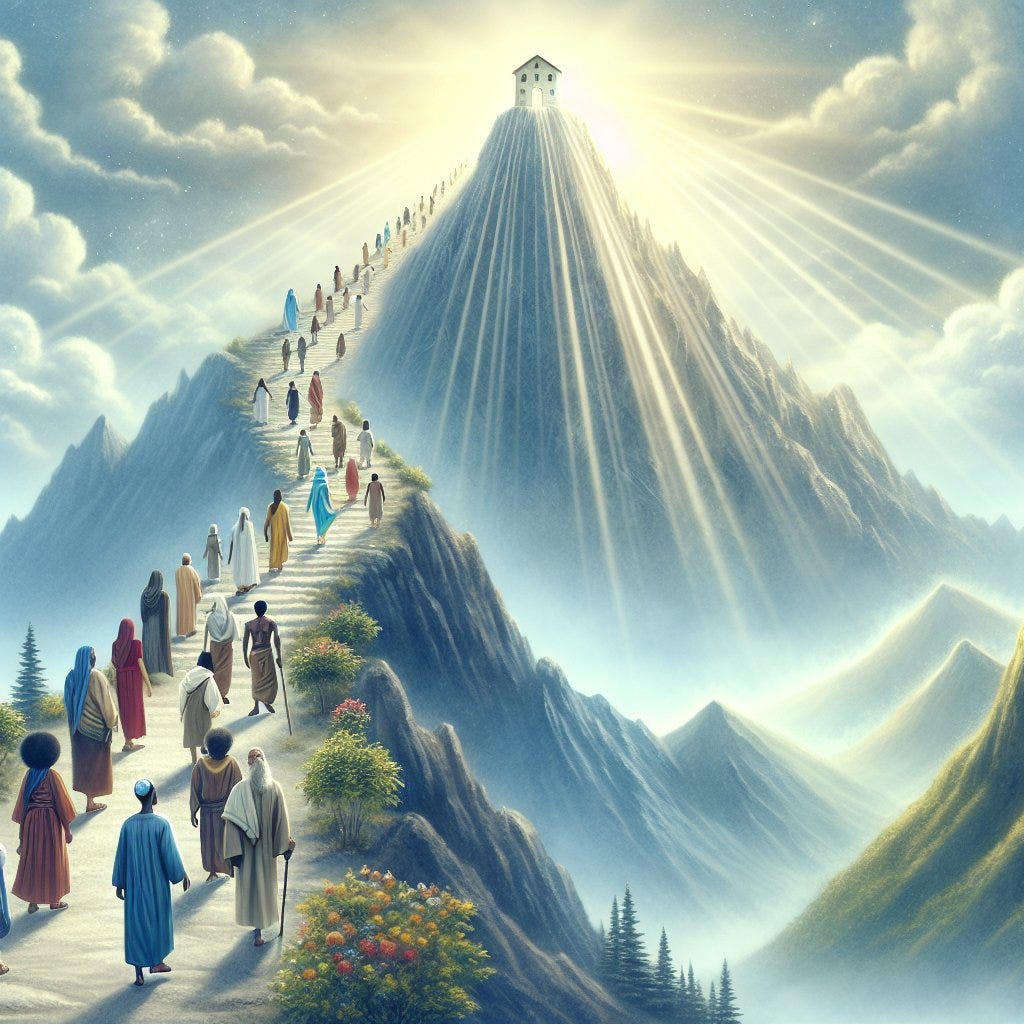
Isaiah 2:2-4 :: 2 In future days the mountain of the Lord’s temple will endure as the most important of mountains, and will be the most prominent of hills. All the nations will stream to it; 3 many peoples will come and say, “Come, let us go up to the Lord’s mountain, to the temple of the God of Jacob, so he can teach us his requirements, and we can follow his standards.” For Zion will be the center for moral instruction; the Lord’s message will issue from Jerusalem. 4 He will judge disputes between nations; he will settle cases for many peoples. They will beat their swords into plowshares, and their spears into pruning hooks. Nations will not take up the sword against other nations, and they will no longer train for war.
Isaiah begins his poetic prophecy with the words in future days, or as BZ says in his sermon, in days to come. He doesn’t have a time frame, did he envision 7 centuries would pass before his prophecy came to fruition? Notice also the reference to all nations. The metaphor the mountain of the Lord refers to Jesus, though at the time of Isaiah, it could have been understood as Israel. In this passage, Isaiah predicts that the effect of the Lord’s teaching will result in humans tending to the world as a garden—humans will stop treating it like a battlefield. Messiah refers to Israel as a single person who fulfils Israel’s calling or vocation or mission. Jesus is the mountain of the Lord. Mount Messiah. In this prophetic poetry references to Zion (Israel) and Jerusalem don’t refer to locales in the modern day geopolitical nation state. There is no nationalism in this poetic prophecy. It makes reference to the root of Jesse.
St. Augustine sermon on Isaiah 2:2 :: The mountain they are all coming to is Christ. Approach the mountain, climb up the mountain; and you that climb it, do not go down it. There you will be safe. Christ is your mountain of refuge. —St. Augustine (354-430)
Who is the One to whom the whole world must look to for salvation? Who is the One whose teaching has gone forth from Zion into the whole world? Who is the One who teaches the world the ways of peace? It’s Jesus. The mountain of the Lord = Mount Messiah = Prince of Peace.
Let’s think about another Hebrew prophet for a moment—Daniel. Daniel found himself amongst the exiles taken from Jerusalem to Babylon. He had an high education and trained to work in government, he worked for King Nebuchadnezzar. In a story told in Daniel 2, Nebuchadnezzar has a disturbing dream and asks Daniel to recount and interpret the dream. Nebuchadnezzar dreamed of a statue with a head of gold arms, chest of silver, belly and thighs of bronze, legs and feet of iron. Daniel gives his interpretation. The statue represents the succession of empires —Babylon, Seleucid, Rome. (Note: Nebuchadnezzar builds a gold statue because of this dream). A stone cut without human hands strikes the statue and the pieces broke off and got swept away without a trace. The stone endures and becomes a mountain.

artwork: The Image Seen by Nebuchadnezzar, Rembrandt van Rijn, 1655 etching, burin and drypoint
Daniel 2:34-35 :: While you were watching, a rock was cut out, but not by human hands. It struck the statue on its feet of iron and clay and smashed them. 35 Then the iron, the clay, the bronze, the silver and the gold were all broken to pieces and became like chaff on a threshing floor in the summer. The wind swept them away without leaving a trace. But the rock that struck the statue became a huge mountain and filled the whole earth.
Christ doesn’t rule over the nations like the emperors such as Nebuchadnezzar, Cyrus, Alexander, and Caesar. G-d wouldn’t have sent Jesus, He would send an army if the world could be saved by killing bad guys. he didn’t though, did He? Does Jesus have to come again for this part of the prophecy to happen? Is there a bit of a rub here — do we have a kind of eschatological kicking of the can going on? Wait. When He came as the incarnation, Jesus established the Mountain of Lord. Will we walk the Jesus Way, as we await His return? There’s no way to peace. Peace is the way. We are AD people not BC people … we are Mount Messiah people ...the ways of empires, the ways of wars aren’t our ways — we turn swords turned into plough shares, spears into pruning hooks. So, let’s start doing that!
In coming weeks of Advent, as we await Christmas —
Branch will grow from root of Jesse prophecy
Redeemed of Lord everlasting joy upon their heads.
Virgin will give birth and His name will be Emmanuel
To repeat —when He came as the incarnation, Jesus established the Mountain of Lord. So, it exists already. Climb that mountain and don’t go down from it, you’ll be safe on the mountain top.