

Lamentation :: How Do We Bear Witness? Do We Even Need to Bear Witness?
why should we care what happens to others? why do we need to get involved? can’t I just be a good person living my best life without knowing or caring what happens in the world of humans around me?


artwork: Lamentations: “The People Mourning Over the Ruins of Jerusalem,” Gustave Doré (1891)
LAMENTATION
Renee Good’s murder set off a whole lot of suffering. Her wife, children, parents, all carry the terrible burden of deep grief for the violent, untimely and unnecessary killing of their loved one. One of the most heart wrenching things I saw from this incident showed Rebecca Good, face covered in her wife’s blood and brain matter, sitting in the snowy front yard of some black man’s house with the dog she and Renee owned, sobbing and in shock from witnessing the point blank execution of her wife by a masked immigration agent just minutes before. That night I experienced terrible trouble sleeping, spent a very restless night in a fitful and broken sleep.
Man: “Why are you asking me for my papers?”
ICE Agent: “Because of your accent. Where were you born?”
Man: “You have an accent too. Where were YOU born at?”
ICE Agent: “Put your hands behind your back.”
source: Tennessee Holler video via X
The near constant stream of video footage coming out of Minneapolis showing the brutality and cruelty of the not-police-officer ICE agents has shocked and upset Americans and people around the world. The reaction of apathy and victim-blaming to the murder of Renee Good and the brutality and aggression of ICE agents in Minneapolis intensifies the horror of what’s transpired. She had it coming, they shouldn’t be protesting federal agents, they shouldn’t provoke the ICE agents — these retorts feature amongst the assortment of merciless responses to the ICE violence perpetrated against the people of Minneapolis. Some responses qual as outright gaslighting and falsehood — she tried to run him over, he nearly died. Minnesota is a sanctuary state, something that’s legal under American law governing division of powers. Perhaps the Trump administration, drunk on its own power, seeks to punish those states who choose not to co-operate with the neo-fascist ideology of the Trump regime.
When Joe Rogan begins to express concerns about a gestapo-like force storming Minneapolis and going door to door hunting for people, has America reached a point where it need to pause and ask some hard questions about the kind of society it wants to or has become? How can Americans have that difficult and uncomfortable conversation when the algorithm-shaped echo chamber culture presents such a formidable obstacle to discourse and exchange of ideas? People have forgotten that discussion means sharing viewpoints and sharpening ideas, not posturing to best each other and win.
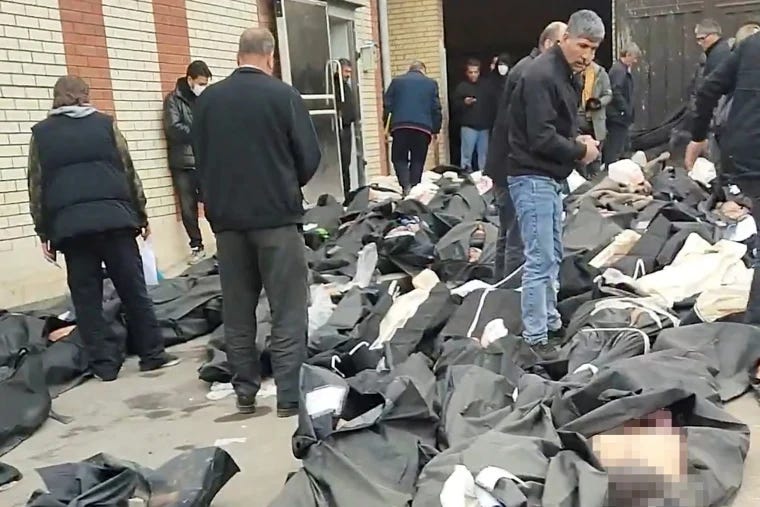
Several members of my local church community1 come from Iran and have family in their homeland. The demonic Islamic regime of Iran continues to brutalise its citizens for activism and protesting. Images of thousands of corpses in body bags, provide evidence of a violent and merciless regime that’s slaughtered innocents for daring to challenge a cruel and fascist and corrupt government. I’ve heard stories of people in my church community who fear for their loved ones in Iran, who’ve had sparse information about what’s happening on the ground in their homeland.
People queued up to identify their loved ones … warehouses with body bags stacked on top of one another … tiny body bags (children) … trucks queuing up to unload dead bodies at the warehouse … relatives in Canada (and elsewhere) besides themselves with worrying and fear in an information blackout. People on the ground in Iran fearful of going to work and yet, fearful if they don’t go to work that they’ll be suspected of protesting and arrested and maybe worst. People whose parents or other loved ones have travelled to Iran for a visit and lost contact with them. The heartbreak and horror knows no bounds. How can the heart and brain handle this level of anguish?
FINDING BALANCE IN THE STORM
I often don’t feel certain that the human brain and heart evolved to watch a continuous loop of brutal death replays on a social media screen. I often don’t think the Creator designed us for this level of chaos and destruction. And yet, when we look at the history of humanity, war and persecution and mass killings and widespread violence and destruction appears often in the pages of the history of the world. I believe that the Creator doesn’t burden any soul with more than it can handle.
She weeps bitterly in the night,
 with tears on her cheeks;
among all her lovers
 she has no one to comfort her;
all her friends have dealt treacherously with her,
 they have become her enemies. — Lamentations 1:2
So, where does that leave us?
It leaves us right here, in the present. It leaves us with a feeling of helplessness, as we try to figure out how we can relieve the suffering. It leaves us with lamentation and bearing witness to suffering.
And the King will answer them, ‘Truly, I say to you, as you did it to one of the least of these my brethren, you did it to me.’ — Matthew 25:40Bearing witness often looks like creating space to listen, observe, validate — with a view to reducing isolation and to sharing human burdens such as sorrow, fear, as well as the suffering of persecution + oppression + hardship. It often begins with gathering information about a situation that happened. It usually entails watching and reading video and written testimony. It frequently involves seeing the depiction of carnage and abuse and violence and grief. It requires us to inject digital things into our eyes and ears that we could never imagine, that we barely understand. Often it’s repeatedly, on an endless 24/7 loop.
We do not want you to be unaware, brothers and sisters, of the affliction we experienced in Asia; for we were so utterly, unbearably crushed that we despaired of life itself — 1 Corinthians 1:8Bearing witness to affliction beyond bearing in the digital age happens on a continuous loop and can feel like limitless agony.
DO WE NEED TO BEAR WITNESS?
Why should we bother, some might ask? Everything sucks, what’s the point? Why make myself miserable for nothing? G-D is in control, just chill out and let Him take care of things. That sounds a lot like spiritual bypass, like cloaking inaction in piety. I would also say, that it depends if you really think bearing witness amounts to nothing. It depends what you value. It depends on whether you choose to maintain your comfort at any cost, or whether you’re willing to soften your heart to the human condition around you and in the wide world. Do you think G-d consoles you and doesn’t want you to pay it forward to others? Why would you think that? What did you think agape love means? What do you think love one another as I have loved you means? Do you see yourself as part of a larger human body? Or do you see yourself as an individual unto yourself, separate and apart from humanity? Letting the world in feels scary and vulnerable. It invites uncertainty and sometimes fear. That’s what it means to live in the world. The challenge becomes to live in the world without drowning it it’s uncertainty, sorrows, chaos, fear, desolation, and terminal despair.
the … Lord Jesus Christ, the Father of mercies and the God of all consolation, who consoles us in all our affliction, so that we may be able to console those who are in any affliction with the consolation with which we ourselves are consoled by God — 1 Corinthians 1:3-4Our culture doesn’t make much space for lamentation, it mostly disapproves, preferring for individuals to adopt a cat like personality in the face of affliction and go off in a hidden corner and lick our wounds privately. To suffer lament openly offends the stoicism so highly valued in our supposedly advanced modern culture. Toxic positivity, the Protestant work ethic fixation with individualism + productivity + self-reliance, an erosion of communal rituals for grieving support, a widespread discomfort with vulnerability and the political weaponisation of affliction via grievance culture all pose obstacles to the spiritual practise of lamentation. Yet we know from the science of the nervous system that sobbing out loud, keening, wailing — expressions which give grief a voice — provide an outlet and a means for healthy self soothing. These responses to grief activate the vagus nerve, which stimulates the parasympathetic nervous system, the part of our nervous system that lowers the heart rate and calms us. Communal rituals for grieving help forge social bonds and build support systems. They help us shoulder the burden of affliction beyond bearing.
“Let all that you do be done by doing love, agape”
WHAT CAN WE DO?2
Discernment — test your feelings. Testing your feelings means engaging in self reflection and determining the origin story of feelings that arise in response to the affliction you witness. Name the feelings, ask where they came from, determine if these feelings wear a disguise — some feelings appear dressed up as other feelings. Envy or fear can masquerade as outrage. Helplessness or fear can masquerade as anger. Guilt can masquerade as guilt. To what destination does this feeling want to take you? What do you want to do with or because of this feeling? How can you put this feeling to use constructively?
Discernment — test the spirits. Testing the spirits around you means distinguishing falsehood from truth. What sources do you trust and what practises do you deploy to discern truth from falsehood? In what communities do you observe discernment? What about disregard for the truth? Where do you see falsehood posing as a truth? Where do you see truth metamorphosed into falsehood? How do you handle falsehoods and the twisting of truth? Do you concede that most communities present a mix of discernment and disregard? Can you overcome the nagging tribal compulsions and see your way to acknowledging the flaws and the strengths of the communities around you? Can you come to terms with the flaws of “your team” and the strengths of “your opponent team,” or do you block yourself from giving any grace to the team or community which you ideologically oppose? Can you resist collectivism to think independently and critically? Can you observe the populist narratives and resist the charismatic allure of those influencers who peddle them?
Confess and Recommit — evaluate your responses and those around you. Confess and recommit entails first observing your responses and those around you … without judgement. Engage this step with curiosity and not condemnation. Compare and contrast. What do you see? Can you tease out motivating factors? What feelings arise when you notice these motivating factors? From where does your cynicism or sarcasm come? How can you shift that towards a constructive response behaviour?
Find Purpose — remember faith, hope and love. Finding purpose requires you to assess your ethics and recalibrate wherever needed. What hope you cling to when all hope seems lost in the chaos of uncertainty and widespread despair? What do you believe against all odds? What relationships and connections give your actions meaning? What commitments ground you? How do find purpose in things larger than yourself? What energises and fulfills you? What practises sustain you during affliction and hardship? What efforts do you find futile? What efforts do you find meaningful? How can you make a difference to others? How can you serve or comfort them? What things within your control can you do or change to help or serve or comfort others?
Social media provides a great vehicle for information dissemination and connection. Algorithms force us into boxes and streams of reaction that diminish our capacity for resilience. Oneupmanship, blame and shame, mimesis and scapegoating—the algorithm incentivises these dysfunctional behaviors and ways of communicating. They intensify affliction, leading to increased suffering. Rather than promoting and participating in grievance culture and toxic positivity and hyper self reliance, we need to create space for lamentation, vulnerability, compassion. Do we need to bear witness? Yes. G-d in control doesn’t mean we can sit back and play ostrich. In fact I would argue that G-d self limits to the degree that He affords us free will. Omnipotence doesn’t mean predestination. We each have free will to choose — we can choose G-d or evil. With each decision we face we make that choice.
Maybe a better world, one with less affliction and suffering, begins with the way we each respond. Maybe bearing witness matters. Maybe creating space for lamentation matters. Maybe we ought to feel our feelings and test them.
We have a diverse congregation with people from Africa and Venezuela, too, and they live with much worry and fear and uncertainty and sorrow about what’s happening in their homeland, where they have family and friends still.
source for the reflection questions in this section are from: Hanna Reichel. 2025. For Such Time as This: An Emergency Devotional. Grand Rapids: William B. Eerdmans Publishing Co.