Chiastic Structure of Genesis 1
the chiasmus of the creation myth and the foretelling of the incarnation

Yesterday I attended the final Open Table Conference (OTC) lecture of 2025. This semester we’ve been engaged in a close study of 1 Corinthians. Yesterday we examined chapter 15, in which Paul discussed universal transfiguration with the Christians of Corinth. In verses 36 to 44, Paul explains the eschatological transfiguration of humanity, using a seed as a metaphor. Sr. Vassa Larin, one of the panelists, noted the reference to the third day of creation, in which G-d created seeds and seed-bearing plants; Sr. Vassa noted the symbolic connection to the resurrection of Jesus on the third day. In his lectures, Fr. John Behr frequently teaches that, through death, we gain eternal life — in accordance with the scriptures. I found yesterday’s OTC lecture and panel discussion an exquisite exegesis and binding together of the creation myth to the gospel of Jesus. I discovered the meaning of this phrase in accordance with the scriptures.
The Biblical Texts
1 Corinthians 15:36-44 :: How are the dead raised up? And with what body do they come?
What you sow does not come to life unless it dies. 37 And as for what you sow, you do not sow the body that is to be, but a bare seed, perhaps of wheat or of some other grain. 38 But God gives it a body as he has chosen, and to each kind of seed its own body. 39 Not all flesh is alike, but there is one flesh for human beings, another for animals, another for birds, and another for fish. 40 There are both heavenly bodies and earthly bodies, but the glory of the heavenly is one thing, and that of the earthly is another. 41 There is one glory of the sun, and another glory of the moon, and another glory of the stars; indeed, star differs from star in glory.
42 So it is with the resurrection of the dead. What is sown is perishable, what is raised is imperishable. 43 It is sown in dishonor, it is raised in glory. It is sown in weakness, it is raised in power. 44 It is sown a physical body, it is raised a spiritual body. If there is a physical body, there is also a spiritual body.
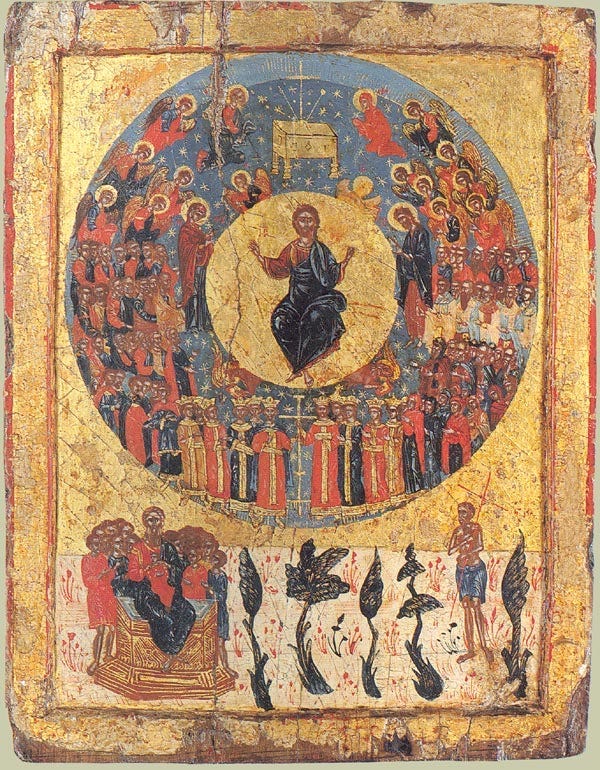
artwork: Second Coming, circa 1700
Genesis 1:1-13 :: 6 Days of Creation
In the beginning when God created the heavens and the earth, 2 the earth was a formless void and darkness covered the face of the deep, while a wind from God swept over the face of the waters. 3 Then God said, ‘Let there be light’; and there was light. 4 And God saw that the light was good; and God separated the light from the darkness. 5 God called the light Day, and the darkness he called Night. And there was evening and there was morning, the first day.
6 And God said, ‘Let there be a dome in the midst of the waters, and let it separate the waters from the waters.’ 7 So God made the dome and separated the waters that were under the dome from the waters that were above the dome. And it was so. 8 God called the dome Sky. And there was evening and there was morning, the second day.
9 And God said, ‘Let the waters under the sky be gathered together into one place, and let the dry land appear.’ And it was so. 10 God called the dry land Earth, and the waters that were gathered together he called Seas. And God saw that it was good.11 Then God said, ‘Let the earth put forth vegetation: plants yielding seed, and fruit trees of every kind on earth that bear fruit with the seed in it.’ And it was so. 12 The earth brought forth vegetation: plants yielding seed of every kind, and trees of every kind bearing fruit with the seed in it. And God saw that it was good. 13 And there was evening and there was morning, the third day.
image: by Alfonso Betancourt on Unsplash
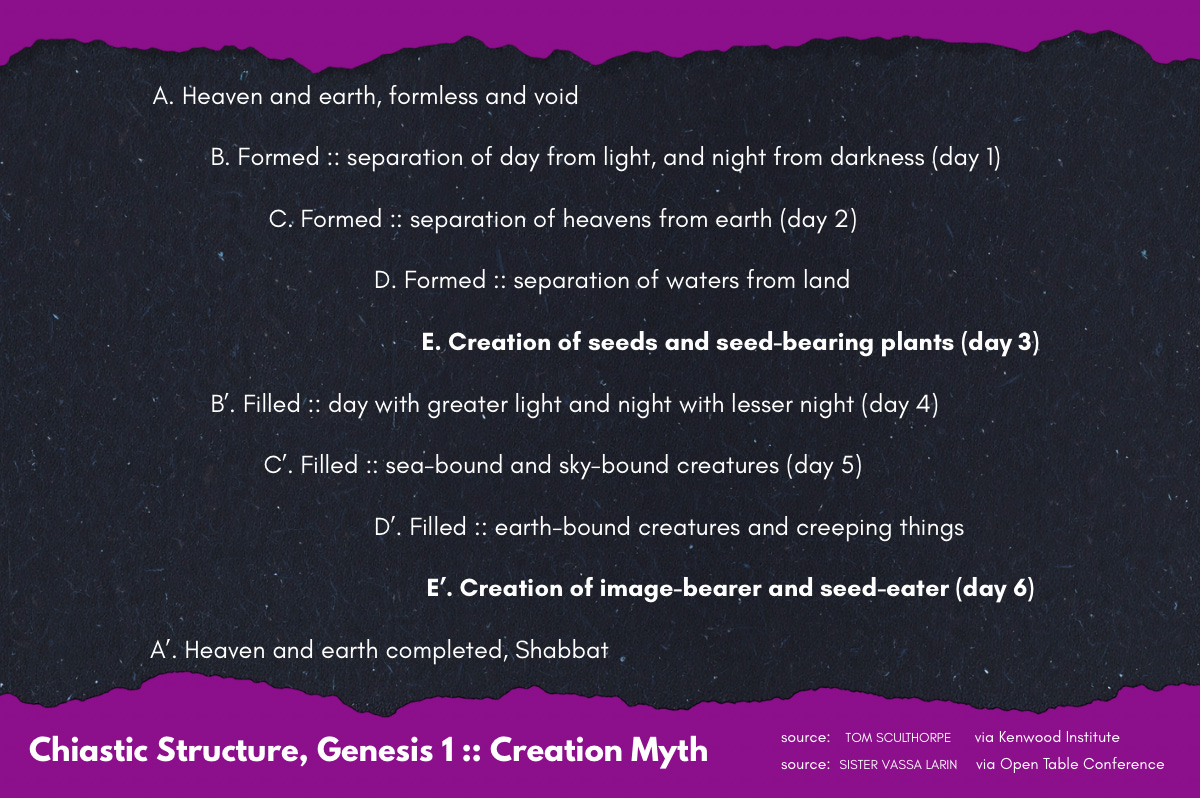
The Chiasmus in Genesis 1
A. Creation of heaven and earth
B. Formed :: separation of day from light, and night from darkness (day 1)
C. Formed :: separation of heavens from earth (day 2)
D. Formed :: separation of waters from land
E. Creation of seeds and seed-bearing plants (day 3)
B’. Filled :: day with greater light and night with lesser night (day 4)
C’. Filled :: sea-bound and sky-bound creatures (day 5)
D’. Filled :: earth-bound creatures and creeping things
E’. Creation of image-bearer and seed-eater (day 6)
A’. Heaven and earth completed, rest
Discussion
In 1 Corinthians 15:3-4, Paul writes 3 that Christ died for our sins in accordance with the scriptures, 4 and that he was buried, and that he was raised on the third day in accordance with the scriptures. Did you catch the key phrase? In accordance with the scriptures, what’s that mean? Take a look at the graphic above, I’ve provided the chiastic structure of Genesis chapter 1. We can divide creation into two parts, each part being three days in length. In the first three days, G-d forms, in the second three days, He fills. Only on day 3 and day 6, do we see the phrase And G-d saw that it was good. On day 3 and day 6, respectively, G-d creates the seed and the seed eater. The seed provides the first embodiment of the resurrection, ie. of life springing forth from death. The word ‘seed’ appears four times in that verse. The word zera זֶרַע (Strongs lexicon 2233) translates to the English as seed, and can also mean offspring, as well as the product of a plant—the fruit-bearing tree yields a fruit which contains a seed in itself. In 1 Corinthians 23 Paul describes Jesus as the First Fruit.
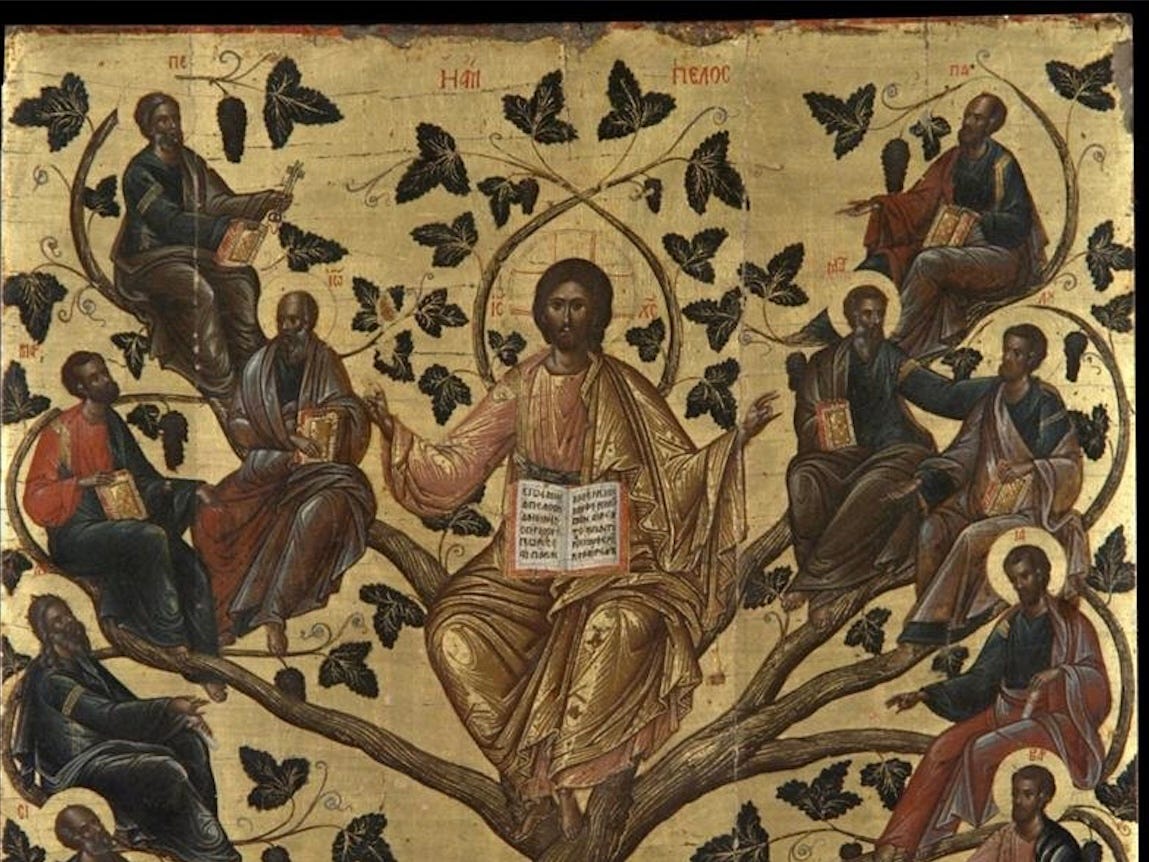
artwork: Christ on a Vine by Leos Moskos, circa 17th century
Question: What’s a fruit? Answer: A seed-bearing structure in a flowering plant.
That makes the triune G-d the Tree of Life, the embodiment of the triune G-d being Jesus. Genesis 3:22 says that anyone who eats from the Tree of Life will live forever. After birthing Him, Mary laid Jesus in a manger. Manger, the French verb for eat, also describes a trough for feeding livestock animals. Through Jesus, G-d made all of creation. Jesus draws all of mankind into Himself, He makes all things new.
The First Fruit has come in human form to feed humans life by conquering death. We should not have eaten the fruit from the Tree of Knowledge Good and Evil, offered us by the serpent, and we should eat the fruit of the Tree of Life, offered us by the Word. And that’s why we celebrate this time of year, why we wait in hopeful anticipation, during this week of Gaudete, Joy — because we know the Tree of Life, we know the First Fruit, we know Logos. He has come, He will come. As we approach the final Sunday of advent, when we light the candle of love, we reflect on the darkness of the season and our yearning for light. We pray, knowing the world could use LOVE right now. Only the darkness can we appreciate the beauty and mercy of the light.